On July 6 seven intrepid observers set out on the Niobrara Valley Preserve’s 34th annual butterfly count. Conditions were incredibly dry (perhaps accounting for the lower overall numbers observed) but we were able to record 28 species and 161 individual butterflies. These totals fell roughly in line with averages for the last 10 years (26.8 species and 188 individuals). Of the 28 species counted, one was a Nebraska Natural Heritage Program (NENHP) Tier 1 species (Regal Fritillary) and another nine were Tier 2 species. NENHP listed species accounted for nearly one third of the species counted. This illustrates the importance of the habitats protected on the Preserve. An additional Tier 1 sighting of a Whitney’s Underwing Moth occurred the night before at lights set up by Neil and Jonathan. The high point of the count was finding multiple (ok only two) Two-Spotted Skippers, one being at a new locality. This uncommon marsh skipper rarely strays far from its niche habitat and has now been found at three locations at the Preserve. Thanks to the count participants – Brandon Cobb, Emma Greenlee, Ashley Oblander, Eric Behrens, Chris Helzer (all from TNC), Jonathan Nikkila and to Amanda Hefner who facilitated logistics for the count.
Two Spotted Skipper, Niobrara Valley Preserve, July 6 2022, photo by Jonathan Nikkila
Eyed Brown, Niobrara Valley Preserve, July 6 2022, photo by Jonathan NikkilaRegal Fritillary, Niobrara Valley Preserve, July 6 2022, photo by Jonathan Nikkila
Thirty four years is a long time to maintain a count. This would not have been possible without all the volunteer observers who have pitched in over the years and the staff (past and present) at the Preserve. Many thanks to all involved!!
Putting to use all the tips, tricks and ID help Neil Dankert has given me over the years, I spent a day during our family vacation to the Pine Ridge last week to hunt for Western Nebraska butterfly species.
My family was staying at Ft. Robinson State Park, a great place for kids and extended family to spend a vacation. We had catered breakfast at the foot of pine covered bluffs. The kids spent hours swimming in the huge indoor swimming pool. We hiked, watched a rodeo and played a game of whiffle ball on the parade grounds, among other things.
Ft Robinson area
Family fun
After the morning family breakfast on Thursday, I snuck away and drove about half an hour west to Sioux County and Gilbert-Baker WMA. My mom, who hears about a lot of my bird and butterfly hunting trips, joined me for the first time. We parked in the campground area, hopped the shallow creek and started down the trail. Right at the start we bumped into a researcher for the Xerxes Society who was doing a bumble bee survey and we said we would keep an eye out for the Western Bumble Bee, a rare species with white hairs on the end of its abdomen. We didn’t see that species, but we did see what I think was a group of Central Bumble Bees, including one that had become lunch for an ambush bug.
It did not take long to see that fritillaries were out in force. In the first big meadow I chased a couple of fritillaries for a while until they rested on a thistle and allowed me to get good photos. One was Aphrodite and the other was Edwards’. We saw a ton of large fritillaries on the trail, many drinking from mud. I should have taken more time to identify each because the next day Matt Brust, a lepidopterist from Chadron State College, visited Gilbert-Baker and may have seen a couple rare species. However, the larger fritillaries look very similar from a distance, rarely like to stay put and I just take photos and don’t use a net, so it is a lot of work to nail them down. I should have persisted but got a little on the lazy side.
Gilbert-Baker WMA
Ambush Bug and possible Central Bumble BeeAmbush Bug and possible Central Bumble BeeAphrodite Fritillary, Sioux Co, J. NikkilaAphrodite Fritillary, Sioux Co, J. NikkilaBlack Swallowtail, Sioux Co, J. NikkilaRuddy Copper, Sioux Co, J. NikkilaRuddy Copper, Sioux Co, J. NikkilaEdwards’ Fritillary, Sioux Co, J. NikkilaIcarioides Blue, Sioux Co, J. NikkilaEdwards’ Fritillary, Sioux Co, J. NikkilaPahaska Skipper, Sioux Co, J. NikkilaEdwards’ Fritillary, Sioux Co, J. Nikkila
On the way back to the trail head I commented that I hadn’t seen many skippers during the two hour hike. Not long after, just a couple hundred yards from the trailhead, I saw a small skipper flit across the trail and I knew it was something special. I yelled at my mom to freeze. Sitting there, feeding on bindweed, was a Pahaska Skipper. I managed a single halfway decent photo before a Ruddy Copper decided to be a bully and scared it away. I took a few more passes to find it but it didn’t return. Pahaska is ranked “S2” by the Nebraska Heritage Program which means it is an imperiled species in the state.
After I dropped off my mom at Ft. Robinson I took over kid duties from my wife for a couple hours — supervising them at the pool. When the kids were finally worn out, I dropped them off at our cabin and drove down the road west of Ft. Robinson to the Soldier Creek campground and trailhead which is in Sioux County. Ft. Robinson’s property straddles the border between Sioux and Dawes counties. I was specifically looking for a lifer Taxiles Skipper, which is also rated as imperiled. I crossed the point where Soldier Creek went across the road and noticed lots of butterflies drinking from the mud along the creek and lots of flowering plants.
The butterflies were concentrated along the road between the creek and where the road tees off at the top of the hill. Among the species I remember were Gray Coppers, a Painted Lady, Melissa Blue, Delaware Skippers, a Dun Skipper,Eyed Brown, Common Wood-Nymph, Variegated Fritillary, Orange Sulphur, Hobomok Skippers, and Long Dash Skippers. I found my target species, Taxiles Skipper, after I had already walked the stretch of road several times. After poking around other parts of the campground and needing to get back for family dinner, I decided to make one more pass of the road by the creek and lucked out, finding two Taxiles Skippers on verbena.
Delaware Skipper, Sioux Co, J. NikkilaDelaware Skipper, Sioux Co, J. NikkilaDun Skipper, Sioux Co, J. NikkilaHobomok Skipper, Sioux Co, J. NikkilaHobomok Skipper, Sioux Co, J. NikkilaTawny Crescent, Sioux Co, J. NikkilaTawny Crescent, Sioux Co, J. NikkilaTaxiles Skipper, Sioux Co, J. NikkilaTaxiles Skipper, Sioux Co, J. Nikkila
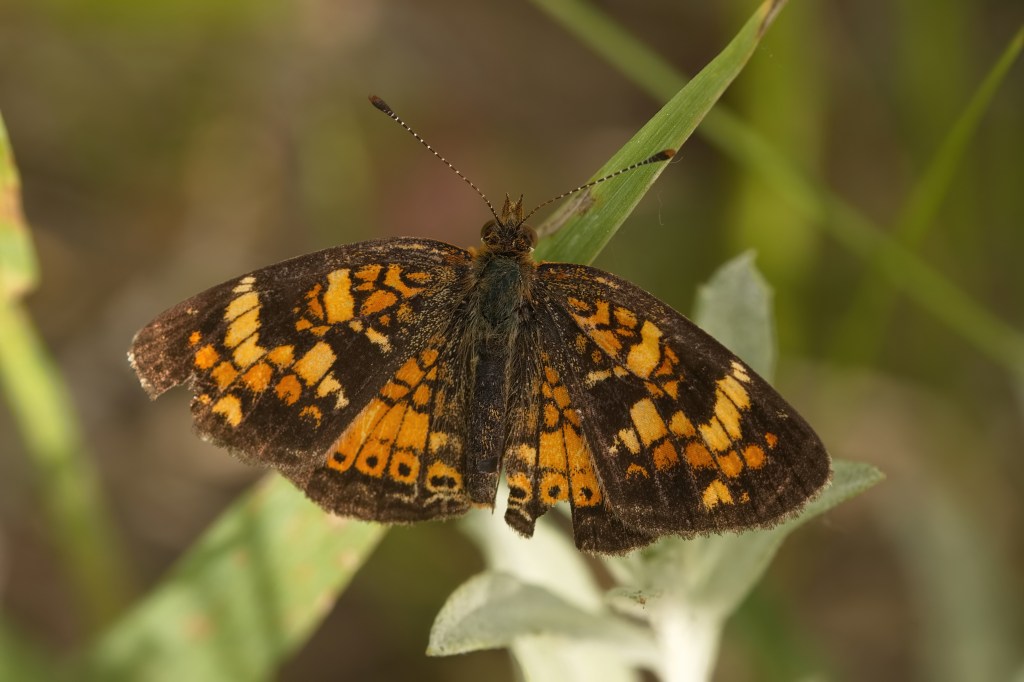
The other butterfly of note was a type of crescent. I noticed it looked much darker dorsally than a common Pearl Crescent. It was drinking periodically from the mud. After taking some good photos from above, I stalked it for about 15 minutes waiting for it to show the underside of the wing so I could verify that I had seen my first ever Tawny Crescent. Unfortunately, it is even more rare and is rated “S1,” “critically imperiled” by the heritage program.
Western Nebraska is a special place for unique, beautiful landscapes and amazing wildlife. Central Nebraska is home and will probably always be, but the Pine Ridge, the Sandhills and Wildcat Hills are the best places in Nebraska to be when I am not at home in Kearney.
Long Dash, Garden Co, J. NikkilaPeck’s Skipper, Garden Co, J. NikkilaPeck’s Skipper, Garden Co, J. NikkilaPeck’s Skipper, Garden Co, J. Nikkila
Back on June 15 Colin Croft sent me a link to some pictures he had taken earlier that day, wondering if I might know what it was. Knowing my limitations I passed it along to Steve Spomer who shared it with Mike Fisher and James Scott. They were in agreement that Colin had found a Field Crescent, Phyciodes pulchella – (formerly P.pratensis). This butterfly is found infrequently in western Nebraska and had yet to be recorded from Scotts Bluff County. The Nebraska Natural Heritage Program has this species listed as S1, Tier 2, making this a really good find. For more photographs and an updated distribution map with the species profile follow this link to the Field Crescent species account.
Phyciodes pulchella, 6/15/2022, Scotts Bluff County, Colin D. Croft
This is a followup to my Sept 2 post from last year. Diane Miller found a bunch of caterpillars at her mother and brothers residences in Platte and Nance counties. She was kind enough to give me a couple. They promptly pupated and I left them in a Folgers coffee container on my workbench in our detached garage. Earlier this month I was looking for a tool and rediscovered them. Both were alive and wriggled when touched. So I rounded up some moist leaf litter and put them in it under a cage. About a week later one adult emerged and I put it in the same Folgers coffee container (I wanted it to feel at home) and into the freezer. Last week I rediscovered it (again) in the freezer and finally got it spread.
Once again these moths (Celerio euphorbiae) were imported to try to contain the spread of leafy spurge in this country (refer back to the Sept 2 2021 post for a more detailed explanation) so they are “curiosities” as an introduced species and are not part of our native moth fauna.
In case you haven’t visited the website https://nebraskalepidoptera.com/ recently major improvements have been made. Through Nebraska game and Parks’ Watchable Wildlife program Jonatan Nikkila and I have overhauled the site. It now features species accounts of all 210 species in the state along with 19 public access sites from across the state where you have a good chance to see many of our native butterfly and moth fauna. It features field photographs with as many species as possible photographed in our state by local enthusiasts.
If you think you may have sighted a new county record or have a butterfly photo you’re especially proud of let us know at nebraskabutterflies@gmail.com. Due to space/financial constraints of the website we probably can’t post every pic but will try to include some on our species account pages. Thanks to all for their interest and patience while we overhauled our website.
Although virtually the entire state is in some form of drought warmer weather is finally here, albeit sporadically. There are multiple reports of Henry’s Elfins from eastern Nebraska but so far the find of this young season was the discovery of a Zephyr Anglewing by Colin Croft who got a photograph of one at the southern edge of Wildcat Hills State Recreation area on April 19. Colin recognized it as something unusual and sent me a pic which I forwarded to Steve Spomer who made the identification. The Zephyr Anglewing is a western species which is likely a resident in Nebraska’s far western counties but in such low numbers years often pass between sightings. So congratulations to Colin. Butterfly season has begun!
Zephyr Anglewing, Banner Co. NE, 4/19/2022, Colin Croft
Well 2021 ended up being a pretty good year for increasing our knowledge of the butterfly and moth fauna of Nebraska. 30 butterfly county records were found, with one of them being a state record (see the list below). In addition Mark Brogie and Barb and Loren Padelford recorded 31 moths never before found in the state. An additional 31 moths new to Nebraska were identified from the UNL collection bringing the total number of new moths to an amazing 62 species. I’ll put up another post when I get these incorporated into the moth spreadsheet. Many thanks to all for their interest and input. Here’s to looking forward to another great year in 2022. Merry Christmas and Happy New Year!
Ocola Skipper taken in Lincoln NE 20 August 2020 – State Record
Butterfly County records for 2021–Silver spotted skipper – Butler (Steve Spomer SMS) and Garfield (Diane Miller DKM) Least Skipper – Scotts Bluff and Banner (Colin Croft CDC), Howard (Jonathan Nikkila JJN), Boyd (Neil Dankert NED) Firey Skipper – Polk (NED), Valley (JJN), Harlan (Jennifer Dankert JLD) Ocola Skipper – Lancaster (Jonathan Xing J X) STATE RECORDPeck’s Skipper – Saline and Boone (NED) Tawny-edged Skipper – Boone (DKM) Hobomok Skipper – Butler (SMS) Roadside Skipper – Scotts Bluff (CDC) Giant Swallowtail – Garfield (Renee McMullen R M) Eastern Tiger Swallowtail – Valley (NED) Checkered White – Wayne (NED) Clouded Sulphur – Boone (NED) Dainty Sulphur – Polk (NED) Coral Hairstreak – Polk (Rachel Kunic Hall RKH) Striped Hairstreak – Rock (Jen Corman JYC) Marine Blue – Custer and Franklin (NED) Gray Hairstreak – Boone and Polk (NED) Lupine Blue – Phelps (NED) Variegated Fritillary – Stanton (JLD) Regal Fritillary – Greeley (NED) Viceroy – Boone (JLD)
If I missed any or you think you might possibly have a record to submit let us know at nebraskabutterflies@gmail.com
OK, you’re probably getting tired of hearing about them but that is about all that is flying that is even slightly interesting. Saturday I accompanied Jen for a day on the Junk Jaunt. Our first stop was at a multi vendor location along NE Highway 2 in Ansley. One of the vendors was selling plants (mums and asters) so of course we had to check them out both for plant opportunities and also to see what butterflies might be hanging around the nectar opportunities they were so kind as to furnish. So of course there was a Marine Blue there which was a Custer County record! The rest of the day passed uneventfully (butterfly wise), but was still a success in my book.
Sunday we rested from our Saturday adventure and made a new plan for Monday which ended up being an afternoon road trip to Harlan and Franklin counties. One of our butterfly hunting strategies is to check out city parks and see what might be blooming and what might be hanging around the flowers. That strategy paid off in Orleans (Harlan County) where at the fairgrounds there was a nice assortment of mums and marigolds. After visually sorting through the Sachem skippers we finally located a couple of Fiery Skippers which hadn’t yet been reported from Harlan County. That brought the Harlan County species count up to 67. With no other prospects for county records there we headed east toward Franklin County where we hoped to find a Marine Blue.
Once past Harlan County Reservoir we took the river road east in search of any alfalfa field that had thus far escaped the fall cutting. We found none but did find several asters covered with a sundry assortment of butterflies but no Marine Blues. We reached Franklin (the town) and followed the signs directing us to the fairgrounds, hoping to duplicate our Harlan County success. Before we reached the fairgrounds we came upon the alfalfa field in bloom we had been searching for, complete with a plethora of butterflies. After about twenty minutes of searching a Marine Blue finally perched in front of us to complete our quest for the day.
The 90 degree temps have given way to the 60s. The cottonwoods are starting to drop leaves. Time is marching on and the butterfly season is definitely winding down. Here’s hoping for a few more weeks!!
Master Naturalist Colin Croft contacted me to report another county record for the Dainty Sulfur (Nathalis iole), this one from Scotts Bluff County where he has sighted/photographed it on numerous occasions. Many thanks Colin!!
Nathalis iole, 7/10/2019, Wildcat Hills, photograph by Colin Croft
That leaves eight counties without iole records. We likely won’t get them knocked out this year but be on the lookout in the few remaining weeks of the “season”.
This past weekend Jon Nikkila and Jen and I both found Firey Skippers (Hylephilaphyleus) in previously unrecorded counties, Jon in Valley County and Jen and I in Polk County. In addition both Jon and I have seen Marine Blues (Leptotes marina) in our yards here in Buffalo County. Last weekend I saw one in Stanton County as well which, to my surprise, was not a county record. Apparently both of these southern species might presently be found statewide. Check the distribution maps below to see if you may be somewhere that still needs records for these species and be on the lookout for them. If you find any new records let us know at nebraskabutterflies@gmail.com.
Firey Skipper – photo by Jon NikkilaMarine Blue – photo by Jon Nikkila
In addition Jen and I found two Dainty Sulfurs (Nathalis iole) at some sandy barrens and a Gray Hairstreak (Strymon melinus) on alfalfa in Polk county where they had not previously been found. From there we went searching for wetlands that might hold Least Skippers and Viceroys. We did find some promising sites but neither of the butterflies. We’ll have to check them again next year. To cap off the day we saw a Red-spotted Purple in a friends yard in Osceola which verified an old 4H record.
Plus we managed to snag/tag and release three Monarchs. All in all a pretty productive September day conditions being what they were – temps in the 90’s and a boisterous wind out of the south.
Thursday afternoon (9/16) we went looking for Monarch butterflies to tag during their migration to Mexico. Waiting for them to find our asters in the yard had not proven to be a winning strategy so we went to a patch of alfalfa where they had been numerous in the past. The weather was warm enough (temps in the low 90s) but a stiff headwind from the south hindered the progress of the migrating Monarchs. Even the reliable alfalfa patch yielded only three Monarchs. Jen then suggested we try Coot Shallows SWMA as it was getting close to dusk and there is a tree sheltered lane that might be conducive to being an overnight perch. Her hunch was spot on and we found the seven more Monarchs that allowed us close enough to catch/tag and release them. I have 50 tags so I still have some “work” ahead but hopefully we’ll get them all put to use. I’ve always thought it was a cruel irony that in September the days warm enough for a cold blooded insect to fly are often accompanied by a stiff headwind out of the south. Combine that with a dwindling supply of nectar sources. I guess that is nature’s way of making sure only the fittest complete the journey to Mexico. Wishing them all the best!!