Last Sunday (July 9) myself, Jonathan and Bennett Nikkila drove to the Niobrara Valley Preserve to do the annual butterfly count the next day. On the way we stopped at the North Loup River just north of Brewster in Blaine County to stretch our legs and check out some wet highway ditches that have been productive in the past. Once again the location did not disappoint. In a short time we found two species “new” to Blaine County – a Delaware Skipper and a Coral Hairstreak, neither rare but nonetheless not previously reported. Another cool sighting was an Acadica Hairstreak (I never get tired of seeing those). This brings the species total for Blaine County to 44 with some other low hanging fruit still out there.
Later that day we explored some areas at the Preserve that we normally don’t get to. That evening we set out lights to check out the local nightlife and followed that up with the butterfly count on Monday. Lots of great findings to report. Stay tuned!! Neil
Coral Hairstreak, North Loup River @ Brewster, Blaine County, NE, 9 July 2023, Bennett C Nikkila
Delaware Skipper, Niobrara Valley Preserve, Brown Co., NE 11 July 2020, Jonathan Nikkila
I recently received this via email. It is an opportunity to contribute to a USGS research project. Note that no Lepidoptera are to be killed. They are only interested in larger (2″ wingspan) already deceased butterflies and moths. I asked about roadkill (roadside and car grill) and they said those were ok to send in. Contact USGS contact with any questions.
I’m still kind of in catch-up mode after spending much of the spring/early summer finishing up the moth addition to our website. Back in April Lori Tomes found a Gray Comma (Polygonia progne) in Saunders County where it had not previously been found. Thanks and congratulations Lori
Gray Comma, Saunders County, Nebraska, 3 May 2023, Lori Tomes
Several new county records for Zebra Swallowtails (Eurytides marcellus) have come in. On June 16 Rita Flohr photographed an uncooperative individual at Rock Creek State Historical Park in Jefferson County. Then on June 23 Mike Vrtiska reported via email that Zebra Swallowtails are common in southeastern Johnson County. Surprisingly Johnson County had no previous records. Jefferson County is probably pushing the western boundary of its larval host plant, Paw Paw trees. I would expect Zebra Swallowtails to eventually be found in Pawnee and Gage Counties as well.
Uncooperative Zebra Swallowtail, Rock Creek SHP, Jefferson County, 16 June 2023, Rita Flohr
Many thanks to Lori, Rita and Mike. Keep your eyes open and the records coming in. nebraskabutterflies@gmail.com
Yesterday afternoon Steve Spomer found a male White-M Hairstreak (Parrhasius m-album) in his yard in Lincoln. This is the third record of this butterfly for the state, the other two coming from Fontenelle Forest. Larvae of this species feed on oaks. Steve said there are a few ornamental oaks nearby, but he suspects the butterfly did not originate from the immediate area. So, as it was likely a stray, the question becomes from where? Bur Oaks (Quercusmacrocarpa) are widespread in southeastern Nebraska but there is as of yet no evidence of a resident population in the state. The White-M Hairstreak is a resident in the southeastern portion of the United States with permanent populations in Missouri and southern Iowa. Heitzman (1987) reports four broods in Missouri flying from April through September. Nebraska’s other two records are from August.
White-M Hairstreak, Fontenelle Forest, Sarpy County NE, Aug 11 2020, JoAnne Langabee
So, questions remain as to this species status in Nebraska. Resident or stray? If a stray are they breeding here. Fertile ground for further investigations. If you live in southeast Nebraska keep an eye out for this butterfly which closely resembles Gray Hairstreaks (note the white M on the ventral hindwing on the picture). The iridescent blue on the dorsal area is also a dead giveaway. If you see this or any other interesting butterfly or one you believe to be a county record be sure to let us know at nebraskabutterflies@gmail.com.
A grant from Nebraska Game and Parks Watchable Wildlife program has enabled us to add several major moth groups to our website. With the assistance of Steve Spomer from UNL we (Jonathan Nikkila and myself) have been able to gather up records and specimens for Silkworm Moths, Sphinx (aka Hawk or Hummingbird) Moths and Underwing Moths for their inclusion.
Silkworm Moths
Silkworm Moths are mostly (but not always) larger, colorful moths. They are generally present for short periods of time as adults do not feed, their only purpose being to find a mate and propagate the species. In addition, many are geographically restricted in our area, their distribution dependent on the presence/absence of their hostplants. Fourteen species have been found in Nebraska.
Luna Moth, Barada NE, 27 July 2019, James Van Bruggen
Sphinx/Hawk/Hummingbird Moths
These moths range in size from large to relatively inconspicuous, some colorful, others drab. This group includes one of the most visible moths visiting our urban flowerbeds, the White-lined Sphinx. Forty-one species have been recorded from Nebraska, most being residents, but a fair number of strays from southern climes also being represented.
Virginia Creeper Sphinx, Knox Co., NE, June 20, 2020, Mark Brogie
Underwing Moths
In Nebraska this group of moths (Genus Catocala in the Lepidoptera family Erebidae) is represented by 52 species. The group’s common name Underwing is derived from the colorful hindwing that is largely concealed by their cryptically marked top (fore) wing. When disturbed when they reveal their brightly colored hindwing which is thought to startle predators and allow the moth to escape. At rest these moths are often found on tree trunks where they blend in and are difficult to locate. These moths fly almost exclusively at night but can be attracted to lights or baits. Depending on species the larvae feed exclusively on one or a closely related species of woody plants. As such their distribution is largely limited by the presence of their hostplant. These moths are notoriously difficult to identify.
Little Underwing Catocala minuta
The addition of these moth groups opens up a whole new set of opportunities for citizen scientists. Check the distribution maps when you find one of these moths to determine whether or not it is a county record. If it is or if you are uncertain of its identity send us a photo and we will do our best to identify it. Understand that not every photo will have enough detail to be identified. Let us hear from you at nebraskabutterflies@gmail.com.
One of the more rewarding aspects of photographing/collecting Lepidoptera is the occasional discovery of a species new to an area (and/or well outside it’s known range). Such is the case with Spiny Oakworm Moth (Anisota stigma). Or is it the Manitoba Oakworm Moth (A. manitobensis)? Both of them belong to the Lepidopteran Family Saturnidae (discussed in the previous blog post) which we are adding to our website later this spring.
Back in 2005 (July 15 to be exact) Barbara and Loren Padelford discovered and photographed an interesting moth at Smith Falls State Park which was determined to be a Manitoba Oakworm Moth which had not yet been found in Nebraska. This was quite a discovery as according to the Moth Photographers Group website the nearest record of this moth to Nebraska was in southern Manitoba, some 600 miles distant.
Anisota stigma, Smith Falls State Park, Cherry County, BP
In researching the genus Anisota we discovered a record of a sibling species (A. stigma) from Brown County (probably the Niobrara Valley Preserve) by Roy Beckemeyer on July 22, 1998. This was also quite a find as the other nearest records were from eastern Iowa or Oklahoma, both also roughly 600 miles distant. At this point I thought maybe I should look at the moths I had collected over the years from the Niobrara Valley Preserve to identify at a later date. Lo and behold there was another Anisota (which looked like A. stigma), also from Brown County in 1998 (July 2).
Anisota stigma? Niobrara Valley Preserve, Brown County, NE. July 2 1998
At this point we sent pics of my Niobrara Valley Preserve and the Padelford’s Smith Falls specimens to Dr. James Tuttle (North American Saturnid Moth expert). He was quite surprised to find either species in Nebraska but was of the opinion that the NVP specimen was A.stigma. He was also on the fence as to whether these are two species or one and suggested DNA analysis might be needed to make a clear determination (if that was indeed possible). To that end I donated my specimen to the UNL collection where it is available for future research. There have been no records of these moths for nearly 20 years, although this might be the result of not looking for them.
Finding these moths in north-central Nebraska was surprising in that there are no records nearby. On the other hand, it is somewhat surprising (to me anyway) that there are no other records for the state even though the larval stage of both “species” feed on oaks which are widespread across eastern Nebraska. So, look back through your old moth pictures and collections. Maybe there are more “treasures” there waiting to be discovered. Let us know what you find at nebraskabutterflies@gmail.com.
This is one of the moth groups we will be adding to our website later this spring.
Moths in the Lepidopteran Family Saturniidae are commonly called silkworm moths although the moth used by the Chinese to make silk is actually a member of a closely related family (Bombycidae). Nonetheless many Saturniid Moths spin cases of silk in which they pupate. There are about 2,300 members of the Family worldwide, just about 100 in North America and 12 recorded from Nebraska.
Rarely common, these moths run the gamut of being some of the largest (Cecropia and Polyphemus Moths) most conspicuous moths to being fairly small and innocuous. Most, if not all, lack functioning mouthparts and do not feed as adults, subsisting on the energy they “brought with them” from the larval stage. Thus, their adult lifespan is fairly short and when their energy reserves are depleted they expire. The sole function of adults then becomes propagating the species.
To this end females emit pheromones to attract males which have large feathery antennae to detect said pheromones and follow them to their source, the female. Larvae feed on trees or shrubs with some species being host specific and others being generalists.
While there are a few late summer records the larger species are generally restricted to a single spring-early summer brood annually while some of the smaller members of this group are capable of producing multiple generations. This group overwinters as pupae.
More on some of the amazing moths we will be featuring on our website will follow in the coming days.
I hope everyone had a safe and happy holiday season. We have great news for 2023!! Through the Watchable Wildlife Program, Nebraska Game and Parks has funded an expansion of our Nebraska Lepidoptera website that will enable us to cover species from three of the more conspicuous and/or identifiable moth groups found in our state. These groups are the Families Sphingidae (Sphinx, Hawk or Hummingbird Moths), and Saturnidae (Silkworm Moths) and the Underwing moths (Genus Catocala in the Erebidae Family). Joining Jonathan Nikkila and myself (Neil Dankert) in this endeavor is Steve Spomer from the Entomology Department at the University of Nebraska Lincoln. While I have focused on butterfly distributions over the years Steve has been compiling records for Sphinx and Underwing Moths. Without his collaboration inclusion of these unique moth groups would not have been possible.
Polyphemus Moth (Silkworm Moth Family)
Lettered Sphinx (Sphinx Moth Family)
Whitney’s Underwing Moth
We think that the addition of these moth groups will add to viewers enjoyment of our Lepidoptera fauna and increase opportunities for participation in citizen science. Additional posts about these moth groups will be coming in the near future. Stay tuned.
Recently Steve Spomer (UNL) came in contact with an amazing moth enthusiast in Cedar County. It turns out that Eric Strehlow had a childhood interest in insects that was rekindled around 15 years ago. Since that time he has been hugely successful in developing and refining bait traps to attract moths in the oak woodlands along the Missouri River. He reports that on occasion he has lured in upward of fifty underwing moths in a night. In the course of running these bait traps he also has attracted some woodland butterfly species. In addition to finding Northern Pearly Eye and Goatweed butterflies he’s also found California Tortoise Shells and Compton’s Tortoise Shells, the latter two being very rare in the state. All of these are Cedar County records.
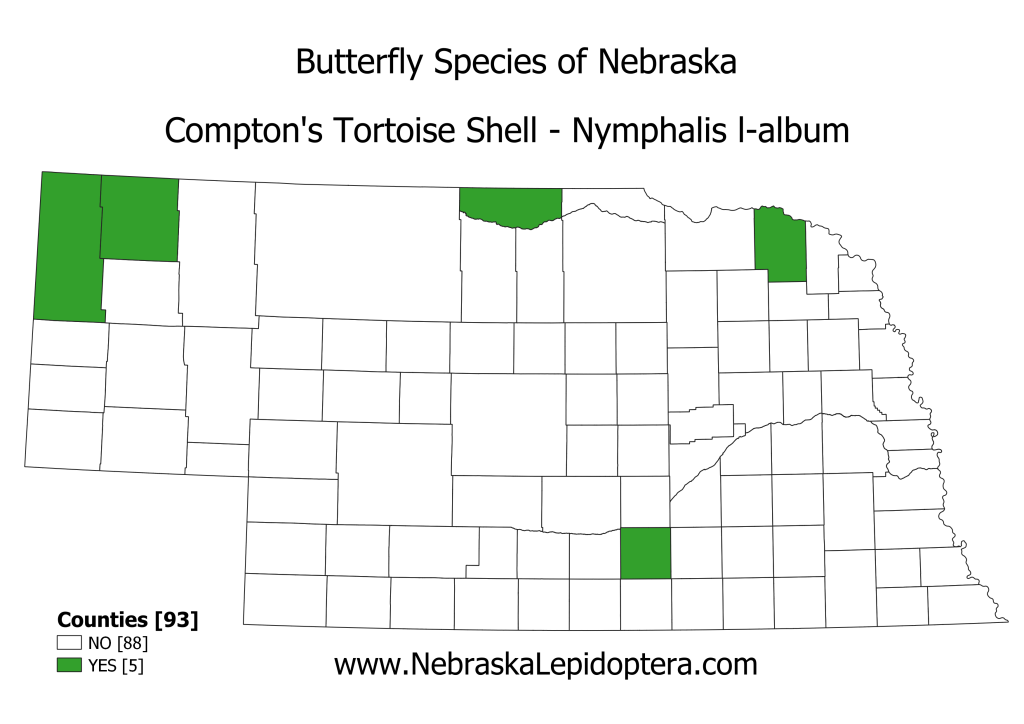
Compton’s Tortoise Shells are northern in distribution where they inhabit deciduous woodlands. The species is thought to be a stray in Nebraska as there are only five records over the past 120+ years. A truly exceptional find!
California Tortoise Shells are another butterfly that rarely strays into Nebraska, this time from the west where it is also found in/near woodlands. Another fantastic find with Cedar County being one of only four counties where it has been found. It was found in Sioux and Scotts Bluff Counties earlier this summer but Eric found them in his bait traps in Cedar County both this year when he found several and last year (2021) when five showed up in his traps.
Nymphalis californica, Sioux Co.., NE, July 11, 20221 Colin Croft
While not as rare Northern Pearly Eye and Goatweed butterflies are both good finds (click the links above). Finding Eric was a stroke of luck. He will have an amazing amount of data to share. If you are aware of anyone in your area that may have an interest in butterflies and moths please have them get in touch with us at nebraskabutterflies@gmail.com.
A couple more October county records to report: On October 16 Colin Croft photographed a Crescent butterfly in the Wildcat Hills of southern Scotts Bluff County. We forwarded the photograph to Steve Spomer at UNL who shared it with other experts and identified it as a Mylitta Crescent (Phyciodes mylitta). Scotts Bluff County is only the fifth county in the state where the Mylitta Crescent has been found (it is primarily western in distribution). It is ranked as an S1, Tier 2 species in the Nebraska Natural Heritage Program administered by the Nebraska Game and Parks Commission.
Mylitta Crescent, Wildcat Hills, Scotts Bluff Co NE, October 16 2022, Colin Croft
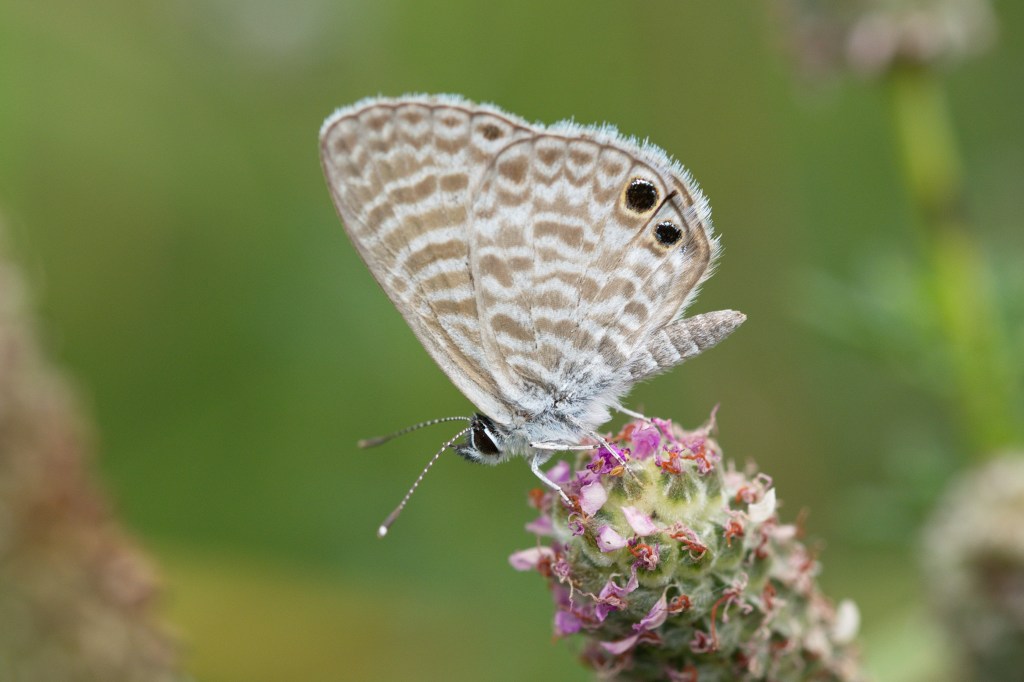
Then on October 20 Jim Reiser took time out from catching (and releasing) fish in Boyd County to observe a Marine Blue (Leptotes marina) where it had not previously been reported. Which answers my question as to how far north this southern stray made it this past summer. At least to the South Dakota border. That makes 17 county records in Nebraska for this butterfly in 2022. Now I’m curious as to whether this influx is a one year phenomenon or will be part of a longer trend.
After a couple of frosts and a light freeze the weather has been great here in central Nebraska. Most of the nectar sources and butterflies are gone but a few of each are still hanging on. Perhaps we can record a county record in November!! Let us know if you see anything you consider noteworthy at nebraskabutterflies@gmail.com.