More New Moths

The other day I got an email from Colin Croft who resides in the Scotts Bluff area and is an avid observer of the natural world (including Lepidoptera). Colin had connected with Chuck Harp (curator of the insect collection at Colorado State University in Fort Collins) and sent him some moths to identify. Chuck identified Colin’s specimens and posted the identifications on Ecdysis, an online arthropod search engine. So, I searched Scotts Bluff County and scrolled through the results. Amazingly Colin had found eight species previously unreported from Nebraska. All were western in distribution with Colin’s records being the easternmost in North America. They are as follows:

Lithophane itata Larvae feed on junipers. Adults emerge in the fall, overwinter, and breed in the spring.

Lithophane ponderosa Larvae of this species feed on Ponderosa Pine. The adults mottled appearance resembles pine bark providing them some protection from predators when resting on tree trunks. Adults emerge in the fall, overwinter and mate the following spring to begin the next generation.
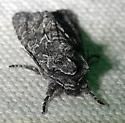
Lithophane ponderosa

Xylena brucei Bruce’s Swordgrass Moth – Larvae feed primarily on Bitterbrush (Purshia tridentata). Adults emerge in the fall, overwinter and re-emerge in the spring.
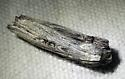
Xylena brucei

Cucullia albida is a rarely reported moth with Scotts Bluff being the southeastern most North American record. Little is known of its life cycle.

Phigalia plumogeraria Larvae are generalists, feeding on apples, plums, willows and Antelope Bitterbrush. Females are flightless, emitting pheromones to attract males who have plumose (feathery) antennae they use to follow the pheromone to its source. Unfortunately the antennae of Colin’s specimen are hidden from view under its wings. After completing the larval stages the larvae drop to the ground and pupate in the soil where they overwinter. Adults emerge in the spring to start the cycle again.

Phigalia plumogeraria, Scotts Bluff County, NE, 3/25/2020, Colin Croft

Egira crucialis Larvae feed on a wide variety of woody plants including Antelope Bitterbrush. Most records are from the Pacific Coast states with Colin’s Scotts Bluff County find being North America’s easternmost. Adults can be found in early spring.

Egira crucialis, Scotts Bluff County, NE, 10 April 2020, collected by Colin Croft

Egira simplex Larva feed on various hardwoods and conifers. This moth flies in early spring and is uncommon to rare east of the Pacific Coast states.

Drasteria inepta Information on the early stages is lacking. Adults are bivoltine, flying in early and late summer.

Drasteria inepta, Scotts Bluff Co., NE, 19 April 2022, Colin Croft

One characteristic all these moths share is that they are all spring fliers. Most moths “newly reported” for Nebraska tend to be obscure “micro-moths” but all of these are larger but had escaped notice due to their early flight period. There are still discoveries to be made in our great state so start checking your lights as the temperatures warm.

Plants for our Insect Friends

Several days of snow and sub-zero temperatures (not to mention “brisk” breezes) were bringing on a case of the winter blahs. Then I open my email and there’s a Nebraska Statewide Arboretum newsletter. Pictures of green things – instant cheer! Then it gets better. There is a Zoom presentation March 13 on the importance of Oaks, Willows and Prunus (plums and cherries) in supporting native insects. Must see “TV”. Registration is required so use the link above and search for “Winter Talks”. The Statewide Arboretum also hosts “The Spring Affair” (see the newsletter) and several other plant sales at their Lincoln greenhouses throughout the year. Consider becoming a member.

Two-tailed Swallowtail larva on Chokecherry (Prunus virginiana)

On the topic of plants and insects, if you haven’t read it, you should check out the NebGuide on “Butterfly Gardening”. It’s a very helpful tool to use when landscaping your property to maximize the use of plants beneficial to butterflies throughout their life cycle.

When choosing plants beneficial to other critters we share our world with it’s important to include plants native to our area. They will require less maintenance (great for you) and have a unique relationship beneficial to both plant and animal built up over millennia. In recent decades horticulturists have bred many landscape plants for certain features to make them more attractive. Sometimes, while developing these “eye candy” cultivars, other traits that made them beneficial to our wild friends are lost or diminished. So, if possible, plan to include some “wild” material into your landscape.

Unfortunately, there is often a sparse selection of many “natives” available at commercial nurseries. Also, the same plant originating from a different region may react quite differently to your local conditions. So, it is also important to get locally sourced plants as often as possible. Luckily for us there are several great local sources for native plants you might want to check out. The first is Midwest Natives Nursey located in Lincoln. It’s 2025 spring plant list is out. It is a brick and mortar business (no mail order) but you can preorder for pickup at the greenhouse. Sign up for the mailing list for opening dates, hours, etc.

Another great local plant source is Prairie Legacy based in southeast Nebraska. This is an online plant store (no brick and mortar location) that offers a great selection of native live plants (grasses, forbs, trees and shrubs) or seeds (individual species or premixed) delivered to your door. Bulk seed mixes for larger projects are available.

Stock Seed Farm based in Murdock sells a wide variety of native grass and flower seeds. Flower seeds are available in packets, ounces or pounds. Grass seeds are sold by the pound. An assortment of pre-mixed seed selections is also offered. This is another great source for larger projects.

After this past week spring might seem a long way off. But hopefully it’s closer than the recent cold snap would lead us to believe. If you’ve decided to add plants to your property this spring it’s time to make a plan. Please consider our insect friends and include some locally sourced native plants. And don’t forget to sign up for the Oaks, Willows and Prunus presentation.

James and Brian’s Excellent Adventure

On pages 185-193 of the 2024 winter edition of News of the Lepidopterists’ Society (vol 66 #4) James Adams and Brian Scholtens documented the first leg of their Lepidoptera field trip through Nebraska, the Dakotas, Montana, Wyoming, Colorado, Nebraska (again) and Kansas this past summer. The first four pages (185-188) document in text and photos their first two nights in Nebraska (at Halsey and Chadron) where they set up lights to attract moths. In those two nights they found five moth species not previously reported from the state as well as others found infrequently. Unfortunately I couldn’t find a way to link directly to that issue but if you take a few minutes to navigate through the process you won’t be disappointed. It’s a really interesting insight into a trip by some accomplished Lepidopterists on a journey of discovery. First search News of the Lepidopterists’s Society – Yale University. Then use the Browse search, select 2020s and then 2024. Then select volume 66 #4. It’s a large pdf and may take a minute to open but worth the wait.

The five new (to Nebraska) species they found were: Pyrausta volupalis, whose larvae feed on plants in the Mint family, Hydraecia perobliqua (larva feed on figworts), Scotogramma submarina (a high plains resident – this Thomas County record is the easternmost in North America. Larval hostplant(s) unreported), Hadena circumvadis (another easternmost record, next nearest are in Montana and Arizona. Larval hostplant(s) unreported) and Ulolonche disticha (another western species found as far east as Kansas, Texas and now Nebraska. Larval hostplant(s) unreported.)

So if you think moths are boring I’d encourage you to check this out. The authors plan to publish two more installments of their Excellent Adventure with the last featuring a stop in southwest Nebraska. I can’t wait!!

2024 Moth Finds

In 2024 Lepidoptera enthusiasts found six previously unreported species in the state. Moth savant Mark Brogie added three new species from his residence in Creighton (Knox County) – a Four-dotted Agonopterix, Aethes baloghi and a Milky Plume Moth. sageraine (iNaturalist) reported a White-spotted Cankerworm Moth in Lincoln (Lancaster County). Colin Croft attracted a Lethal Pyrausta to lights in the Wildcat Hills (Scotts Bluff County) on July 28. On May 9 Elizabeth Hilkemann photographed Cydia lacustrina in southern Lancaster County.

One Saturnid county record was submitted – a Polyphemus Moth from Colfax County by Steve Spomer. Snowberry Clearwings were newly recorded from Stanton and Cherry Counties (Jason Thiele and Jessica McGinley respectively). A couple of uncommon southern strays found their way into south central Nebraska. A Banded Sphinx was found in Buffalo County by Shelly Rodehorst (third Nebraska record) and a Gaudy Sphinx was found in Dawson County (second Nebraska record) by the Witter family (Emily, Azalea and Ezekiel). Staying in south central Nebraska, Christian Jacobs found a Nessus Sphinx in Kearney (Buffalo County). Closing out the species for which we track county records, Bennett and Jonathan Nikkila attracted an Abbreviated Underwing to their UV light at the Niobrara Valley Preserve (Brown County) this past July while we were there to conduct our annual butterfly count.

Gaudy Sphinx found by the Witter family, recovered by Jonathan Nikkila after being run over by a mower and relaxed/pinned by Steve Spomer (UNL)

Many thanks to 2024’s contributors. I’ve added 2024’s six new moth species to our spreadsheet, bringing Nebraska’s species total for the state to 1,467 (by my calculation). This spreadsheet is available to view/download under the moth tab on our website. Please let us know if you have any information on unlisted species or county records at nebraskabutterflies@gmail.com.

Correction/Addendum

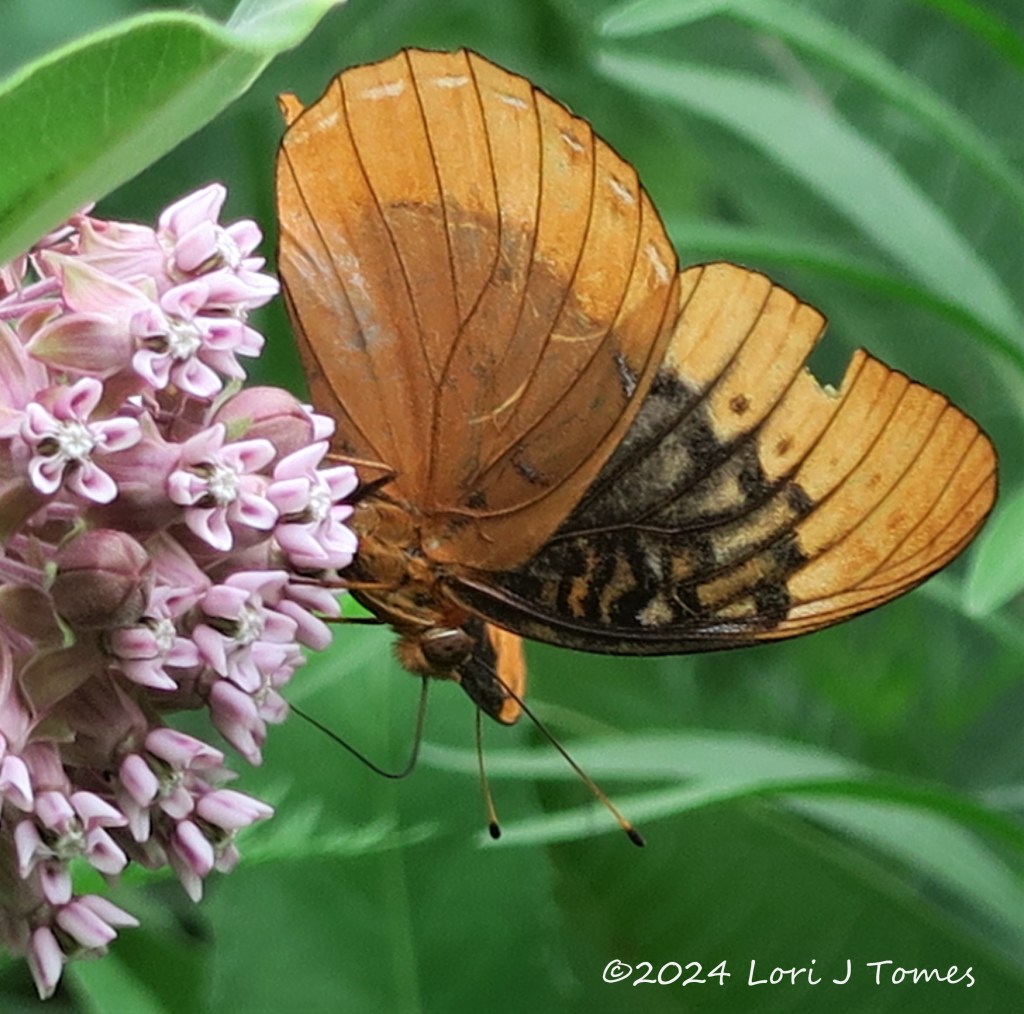
In case you missed the comment, Casey Galvin reached out to provide more accurate information on the populations of Diana Fritillaries from whence the male Lori photographed likely strayed. It turns out there are no resident populations of the Diana Fritillary in Missouri (as I had stated), instead the nearest are in northwest Arkansas/northeast Oklahoma. Which makes Lori’s find even more amazing and shows how little I know about this species. I’ll work with my tech guy to get the Diana Fritillary added to the website.

Also inadvertently omitted from the last post was Jonathan Nikkila’s Gage County Firey Skipper record (September 1) from Homestead National Monument.

So don’t hesitate to reach out to correct any omissions/errors you might find posted here or on the website. Thanks for your time and Merry Christmas!

Thanks to All!!

What a great 2024! I’d like to extend a thank you to everyone contributing records and expand our understanding of Nebraska’s diverse Lepidopteran fauna. On the butterfly side one state record and ten county records were found/submitted. Lori Tomes had the find of the year when she photographed this male Diana Fritillary in Saunders County on June 18 – the first record of this butterfly in the state. There is a permanent Diana Fritillary population in the Missouri Ozarks from which this male must have originated. Great find and photo Lori!

Nebraska Statewide Arboretum’s Blazing Star Award winner Cathy Prettyman found two new species in Washington County – a Funereal Duskywing she photographed in 2019 and a second brood Zabulon Skipper she photographed in Blair on August 23 of this year. Zabulon Skippers must have had a good year as they were reported multiple times, but the only other county record was photographed by Jacob Cooper (a UNK professor) in Howard County (near the western edge of their range) on May 26. Rachel Hall submitted three records for Polk County – a 2021 Northern Broken Dash Skipper, a 2020 Giant Swallowtail and a Hackberry Emperor from July 18, 2024. Terry Mason contributed two new 2024 records from Custer County – an Olive Hairstreak (May 28) and Snout Butterfly (July 25). And on August 24 I found Common Sootywings and Sachem Skippers on alfalfa in Adams County. Thanks again for your interest/participation!

Up next – 2024 Moth findings!

Haven’t Seen That in Awhile

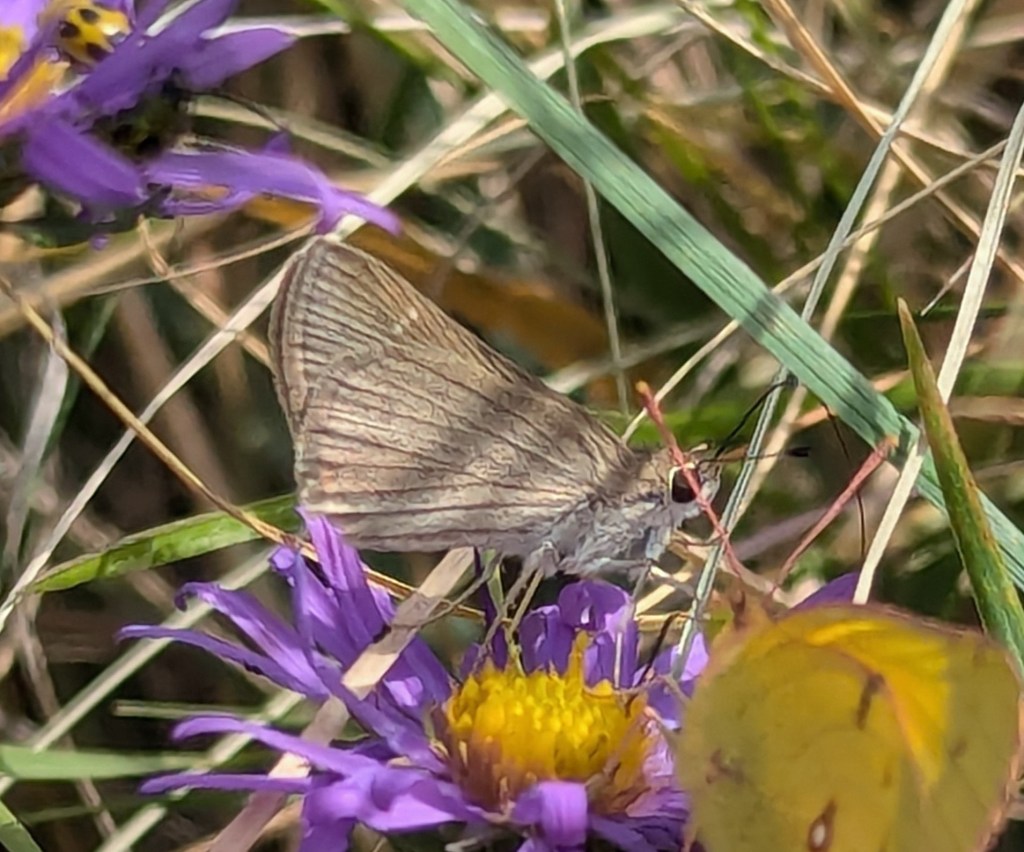
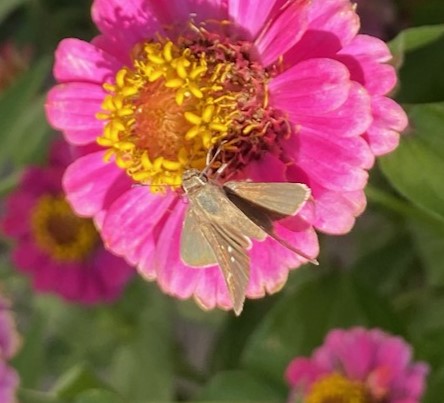
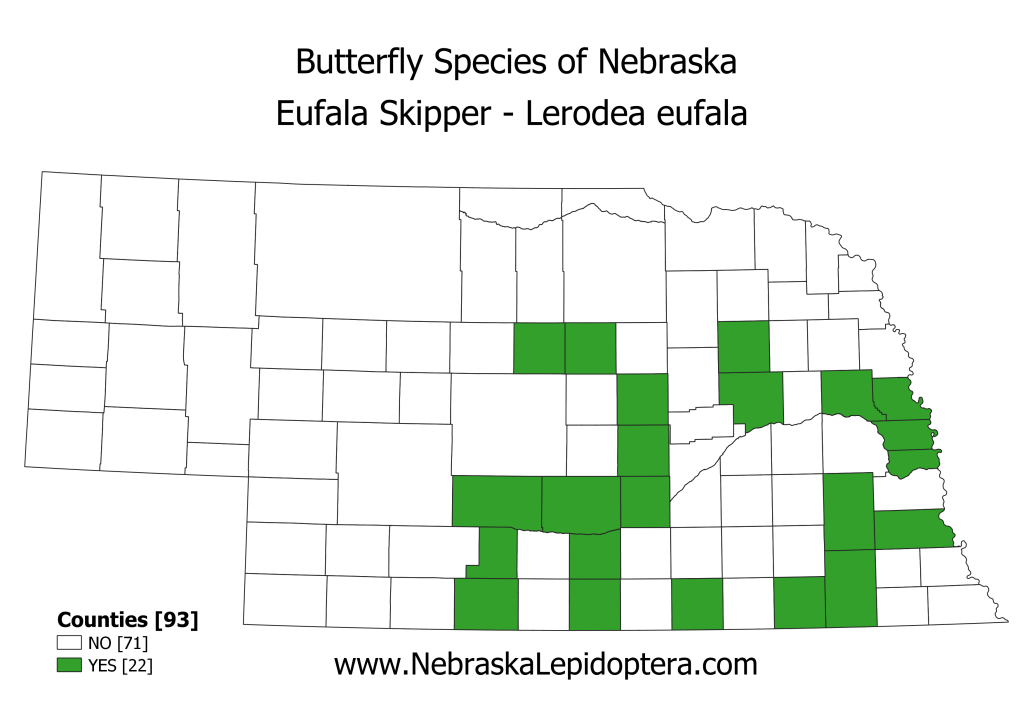
Last Sunday afternoon Jonathan Nikkila was attending the Fall Nature Festival at Kearney’s Yanney Heritage Park (Buffalo County) when he photographed a non-descript skipper. Then yesterday in our yard in Elm Creek (also Buffalo County) I noticed a similar skipper visiting my wife’s flowerbed. Both are Eufala Skippers (Lerodea eufala), a species inhabiting more southerly climes but occasionally visiting our state. I used to see them quite regularly in late summer back in the early 2000s but hadn’t seen one for about 20 years. So that was a pleasant surprise. Still a few days left before a killing frost so make the most of them. Let us know if you find anything interesting (nebraskabutterlies@gmail.com)

Eufala Skipper, Buffalo County NE, 10/20/2024, Jonathan Nikklila
Eufala Skipper, Buffalo County NE, 10/23/2024, Jennifer Dankert

The White M Hairstreak Enigma

Last week (October 10) Loren and Babs Padelford photographed a White M Hairstreak at their residence in Bellevue (Sarpy County) Nebraska. This butterfly is a rather recent addition to Nebraska’s butterfly fauna, first being reported from Fontenelle Forest in 2012. It’s home range includes most of the eastern United States including portions of Iowa and Missouri. Which begs the question – is the White M Hairstreak expanding its range, establishing a foothold in southeastern Nebraska? Or is it a stray? If it is a stray, could it possibly breed here? The Padelford’s latest find appears to be in really good condition which leads me to believe it was not a long-distance traveler. But who knows?

Whatever its status I theorize it is much more widespread in Nebraska than our few records would indicate. Consider the odds of this uncommon butterfly crossing paths with someone who would recognize it. Long odds in my book! It’s been found three times in Bellevue (twice at Fontenelle Forest) and once in the middle of Lincoln, all locations where there are knowledgeable people to observe it (also this species does not appear to be averse to urban environments). Larvae feed on various oaks so there would seem to be potential for it to breed/be found throughout southeastern Nebraska. In any case this is probably not a butterfly that, on any given date, you can set out to find and entertain any reasonable hope of success. Rather just be aware of the possibility of its presence and give any gray hairstreak you see in southeastern Nebraska a second look to verify its identity.

Heitzman (1987) writes that the White M Hairstreak flies in four broods in Missouri with adults on the wing from April through September. The Padelford’s October 10 record pushes that late date out a bit. Being farther north our potential early flight dates are probably a month later (May) as well. So, file this all away and pull it from your memory bank next spring to help unravel the White M Hairstreak Enigma.

White M Hairstreak, Bellevue, Sarpy County Nebraska, 10 October 2024, Loren and Babs Padelford

Two Late Sphinx Moth Records

I apologize for the dearth of posts this past season, but I’ve been fighting various tech issues this past summer. Of course, now that the season has pretty much passed, I think I finally have everything resolved.

Jonathan Nikkila’s insect investigation network has discovered a couple of amazing sphinx moth records. On September 5 Emily Witter sent Jonathan a crayon picture her children had drawn of a moth they had found at the Overton Golf Course (in Dawson County). Curious, the next day Jonathan drove out to investigate. The moth was right where they had seen it the previous day but unfortunately it had been driven over by a mower. While suffering some serious damage it was still recognizable as a Gaudy Sphinx (Amorpha labruscae), reported only once previously in the state (Franklin County). Jonathan retrieved it and gave it to me. I contacted Steve Spomer at UNL who said the university would gladly take it for their museum collection even in its sad state. Thanks again to Emily, Azalea and Ezekiel Witter and Jonathan Nikkila.

Gaudy Sphinx, Dawson Co, NE

Then on September 15 Jonathan was contacted by Shelly Rodehorst who had found a strange moth in her yard in Kearney and took a picture of it. Jonathan rushed over to retrieve it but of course by that time it had moved on. But they had the picture as proof positive and once again it was a rare stray from more southerly climes, this time a Banded Sphinx (Eumorpha fasciatus) with this being only the third sighting in the state. Thanks again to all involved (Shelly and Jonathan) in reporting this amazing find.

Banded Sphinx, Buffalo County NE, 9-15-2024 Shelly Rodehorst