Four More County Records for NE

On June 2 Steve Spomer stopped at the Brainard Cemetery in Butler County and found (among a few other things) Silver Spotted Skippers and a Hobomok Skipper, both of which had not been previously reported from Butler county. Then Friday June 4 Jen and I met Pat and Diane Miller at the Scotia Chalk Mine in Greeley County to look for said Silver Spotted Skippers. While there I saw a Eastern Tiger Swallowtail which to my surprise ended up being a county record. We ended up not finding Silver Spotted Skippers there or in Valley County, but Diane finally located one at a wayside area a couple miles east of Burwell in Garfield County where it was a county record as well. Peck’s Skippers were common there but had been found in Garfield County previously. Those four records along with the Saline County Peck’s Skipper (see the May 25 post) bring our Nebraska 2021 year to date county record total to five. The updated maps follow. To learn more about these butterflies follow the link below the maps.

https://www.butterfliesandmoths.org/species/Epargyreus-clarus

https://www.butterfliesandmoths.org/species/Poanes-hobomok

https://www.butterfliesandmoths.org/species/Papilio-glaucus

Once again, to request a list of butterflies found (or not yet found) from any of Nebraska’s 93 counties reach out to nebraskabutterflies@gmail.com. To submit what you believe to be a new record for a county send a picture and full data (date, location and observer) to the same email. Once again the records designated as 4H records are probably valid but the data for those records never reached me.

New record for Saline County: Peck’s Skipper – Polites peckius

Saturday (May 22) Jen and I went to Lincoln to buy more plants (Statewide Arboretum and Midwest Natives). Although the weather was not ideal (mostly cloudy with a stiff wind out of the south) for butterfly hunting we decided to do a little exploring and take a road less traveled (not Interstate 80) home. Driving west on state highway 41 in Saline County we went past a sign alerting us to the presence of a Willard Meyer Recreation Area. It wasn’t on my DeLorme map so we made a u-turn and went back to check it out. It ends up that it is an NRD development (Swan Lake). We got out and explored one area and drove around and scouted out a few others. There is an interesting mix of habitats ranging from marshy creek bottoms to upland prairies. While hardly anything was blooming and the weather was mostly unfavorable we were able to find Silver Spotted, Common Checkered, Tawny Edged and Peck’s Skippers, Alfalfa Butterflies, Eastern Tailed Blues, and a Summer Azure. Of these Peck’s Skipper had not previously been recorded from Saline County. And the first sightings of Pack’s and Tawny Edged Skippers for 2021. The area is definitely worth a return trip in a month when the weather is more favorable and there are more things blooming.

Peck’s Skipper, The Nature Conservancy’s Caveny Tract – Platte River Prairies, Nebraska, 6/2/20, photo by Chris Helzer
York and Adams Counties are 4H records with incomplete data

This skipper flies in multiple broods and should be found in every county in the state, mainly around, but not exclusive to, wetlands. Larvae feed on Switchgrasses (Panicum sp.). County record opportunities abound! Report any sightings/photos of counties lacking records to nebraskabutterflies@gmail.com

While last year’s Big Year project was fun I almost exclusively went to places I had been to in the past. I did miss the exploring aspect that I usually engage in while traveling. So while this year is going to be more devoted to exploration some part of me obligates me keep a running species total for the year. So 2021’s year to date total is 21 species.

Megathymus yuccae – Yucca Giant Skipper

If you’ve followed me through my big year effort last year this might be a little deja vu from one of my first posts last year. But this year I found a neat video link about this critter from Dr. Andrew Warren at the University of Florida. One neat side note (for me) – Dr. Warren is from Denver and I met him on a chance encounter back in 1991 on M Mountain outside of Golden when we were both looking for Nais Metalmark butterflies (Apodemis nais). He was still in high school at that time, young and full of energy. Even then you could tell that he was not your average novice. Anyway it’s an awesome video, entertaining and full of information. So here’s the link – enjoy!

I wonder if all those collection drawers between the east and west coast specimens were all Yucca Giant Skippers? Wow!

In Nebraska this interesting skipper was a rather recent discovery (in the mid 1980s), probably due to it’s early flight period, the rarity of adults and the desolate appearance of it’s habitat at that time of year. Unless you were looking specifically for this butterfly you would probably not give their habitat a second look as you drove by in early May. Once we were alerted to it’s presence and knew what to look for we were able to find it at a number of locations in western and southwestern Nebraska. Oddly it has yet to be found in the sandhills region although yuccas are common to abundant there.

These skippers should be flying right now (late April – mid May). Finding adults takes a little luck and perseverance. If you go looking keep in mind that these are rare insects so finding them makes for a special day. The tents are somewhat easier to find but still finding one in an hour at an established population is about average. We’ve found tents at Harlan County Reservoir (Harlan Co.), Ash Hollow State Historical Park (Garden Co.) and Box Elder State Wildlife Management Area (Lincoln Co.) in the past. So go check out your local yucca patch. If you don’t find them you may see a few other spring oddities (Silvery Blues Glaucopsyche lygdamus or Olympia Marblewings Euchloe olympia) instead. If you have any questions, see one of these skippers anywhere or take any interesting butterfly pics we’d love to hear from you at nebraskabutterflies@gmail.com

Hunt for Henry’s Elfin Larval Hostplants

What a strange spring (but what does a “normal” spring look like). Once in a while a nice “butterfly day” followed by another week of cold weather. I guess it’s been several weeks ago Jen and I made our annual spring pilgrimage to Harlan County Reservoir to kick off butterfly season. We were met there by Jonathan Nikkila and Dr. Bryan Drew from UNK. Of course the season was a little behind and the only nectar sources were plum blossoms. The temps were only in the 60s but it was sunny and if you stayed on the south side of the trees out of the north wind there were a few butterflies out. We ended up finding around 10 Henry’s Elfins, 1 Juniper Hairstreak, 1 Grey Hairstreak, 1 Anglewing, 1 Tiger Swallowtail, 1 Olympia Marblewing,  1 Dainty Sulphur,  a couple of Red Admirals, Cabbages and Alfalfas, and about a half dozen Baptisia Duskywings in a couple of hours. That was the most Henry’s Elfins I’d ever seen there. And many miles from their southeastern Nebraska larval hostplant, Redbud trees.

I kind of let that pass until Steve Spomer motivated me into writing by reporting he found an elfin at Nine Mile Prairie last week with not a redbud tree in sight. So what are the larvae eating? The butterfly is not known to travel far so it has to be a local host. And if it’s not Redbud, then what is it and where else might it be found. In addition to being a spring flier, it is small, drab and easily overlooked. So it is likely much more widespread than reported. Keep your eyes out for the next couple of weeks for this curious little butterfly and let us know if you see one (nebraskabutterflies@gmail.com). Of the shrubs/small trees listed as larval hostplants in literature, a Prunus species (wild plum or chokecherry) seems most likely in Nebraska. Be alert for this dime sized butterfly in the vicinity of woody shrubs or small trees, on the sunny side of shelterbelts, and on nearby flowers.

Hesperia leonardus pawnee Dodge 1874 Another butterfly described from NE

This is probably one of my favorite group of butterflies (skippers actually). Members of the genus Hesperia are native prairie specialists. Finding any of them today is to rediscover habitat roughly unchanged from what white settlers first encountered when entering our area in the early 1800s. They are the insect equivalents of the American Bison. There are three subspecies of Hesperia leonardus. The nominate subspecies (leonardus) is found in the eastern United States and has a distinct band on the ventral hindwing. Subspecies montana is largely restricted to the Rocky Mountain populations. Subspecies pawnee was described by Dodge in 1874 with the type locality (see Jan 2 post for a type locality discussion) being “Glencoe, Nebraska, upon high rolling prairie (Dodge County)”. While the ventral hindwing of subspecies pawnee is immaculate (largely unicolored and devoid of markings) specimens intermediate with leonardus, with a small degree of maculation, are not uncommon in Nebraska. The species is strongly dimorphic with males displaying a distinct black stigma and females lacking that and being more mottled. The type specimens are thought to be held at the Museum of Comparative Zoology, Harvard University, Cambridge, Mass & Ohio State University.

This skipper inhabits native prairies and flies in a single brood from late August into early September. Larvae feed on various prairie grasses including bluestem and gramma grasses. Windlass Hill at Ash Hollow State Historical Park is a great location to find this skipper as well as Hesperia colorado, another prairie specialist. Traveling eastward this skipper becomes much rarer as prairie habitats degrade/disappear.

Hesperia leonardus pawnee thumbnails (butterfliesofamerica.com)

Butterflies with Type Localities in Nebraska: Lycaena rubidus longi K. Johnson and Balogh, 1977

Pardon my neglect in putting out new material. I’ve been learning some new mapping software to make new distribution maps for Nebraska’s 200+ species (the last ones for the state were put out in 2004/05). I’ve also been comparing notes with Steve Spomer to synchronize our data. So hopefully it will all be worth it. There is a new distribution map for this butterfly a little later in this post. Any comments/suggestions are welcome.

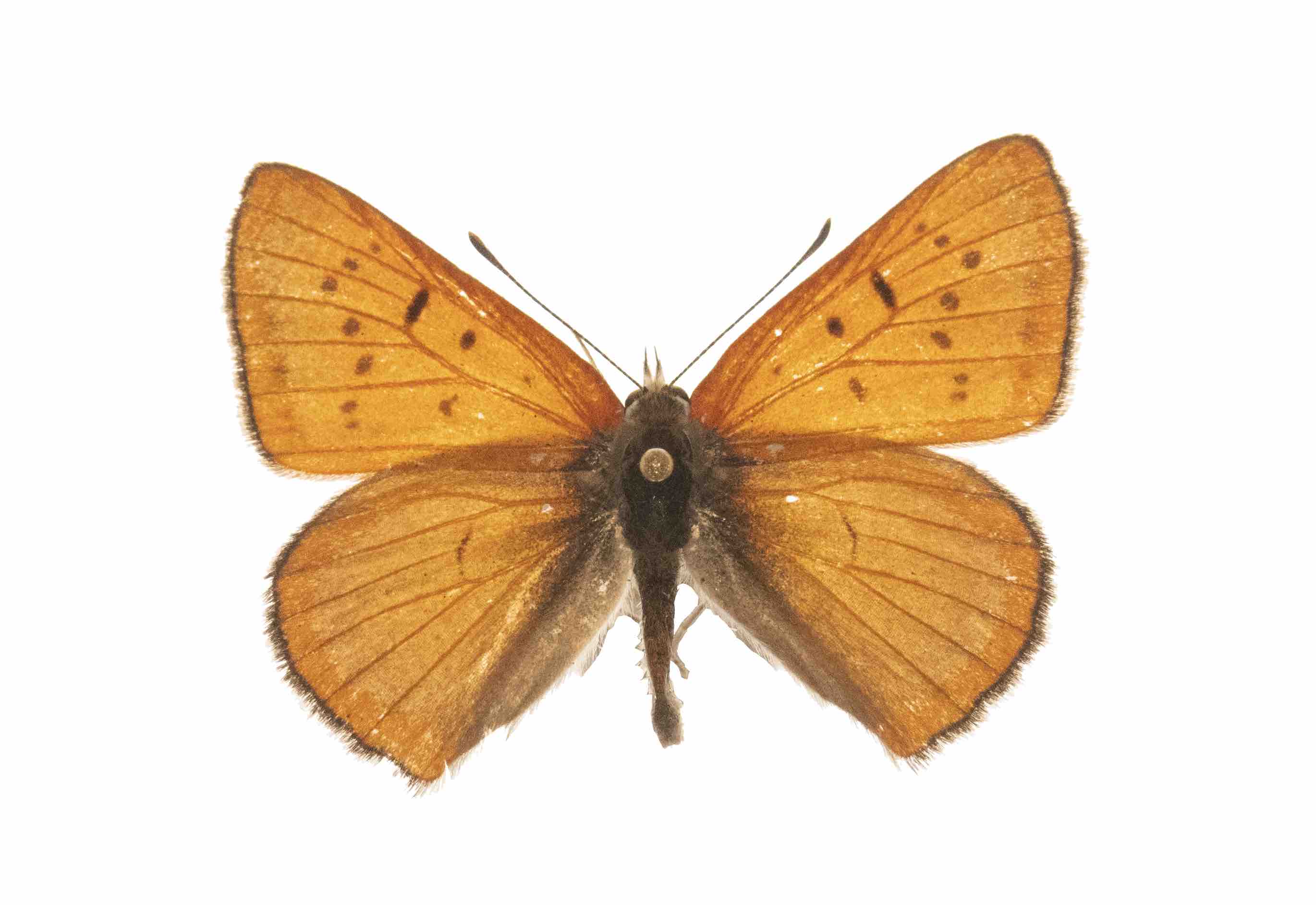
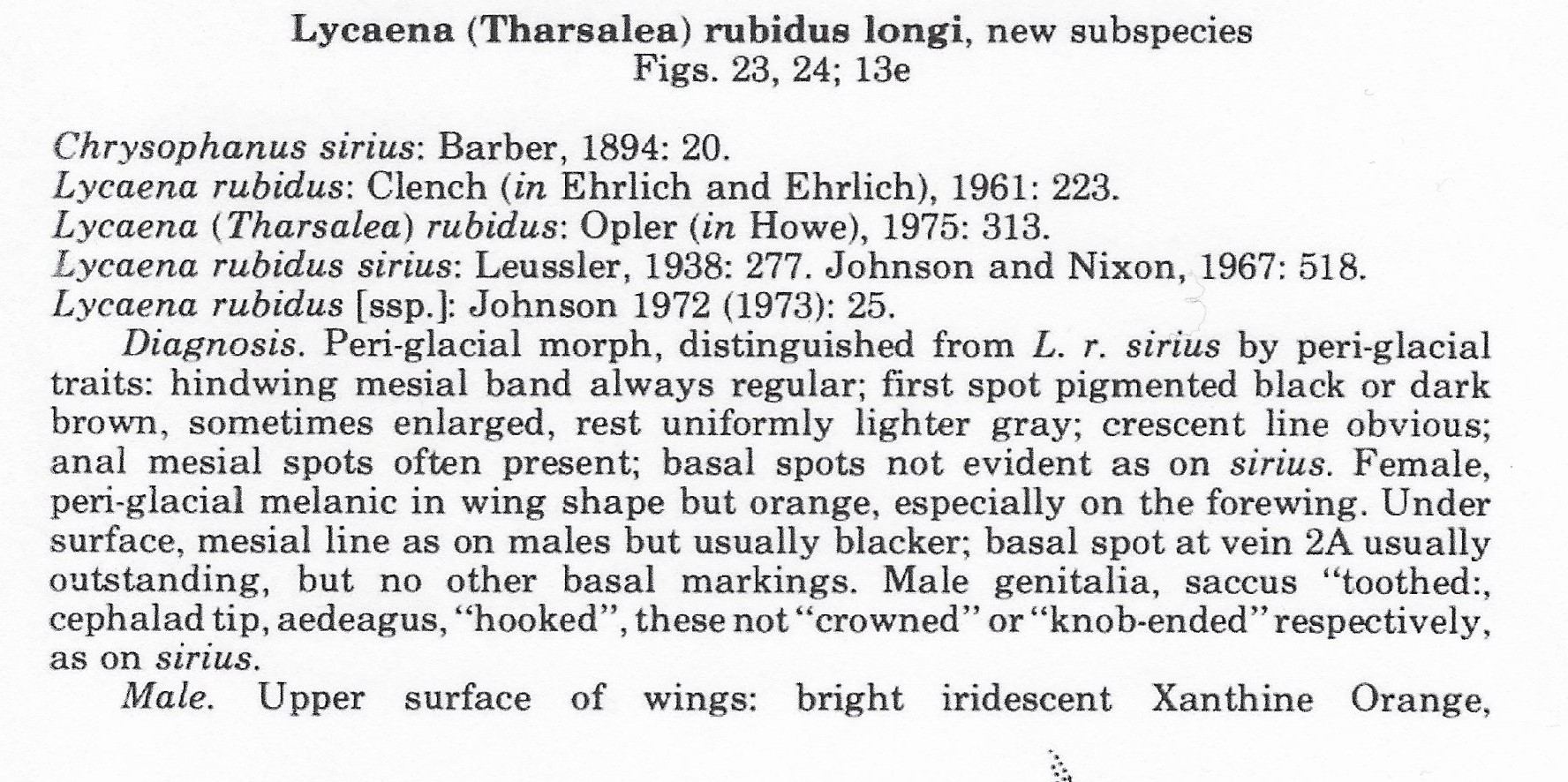
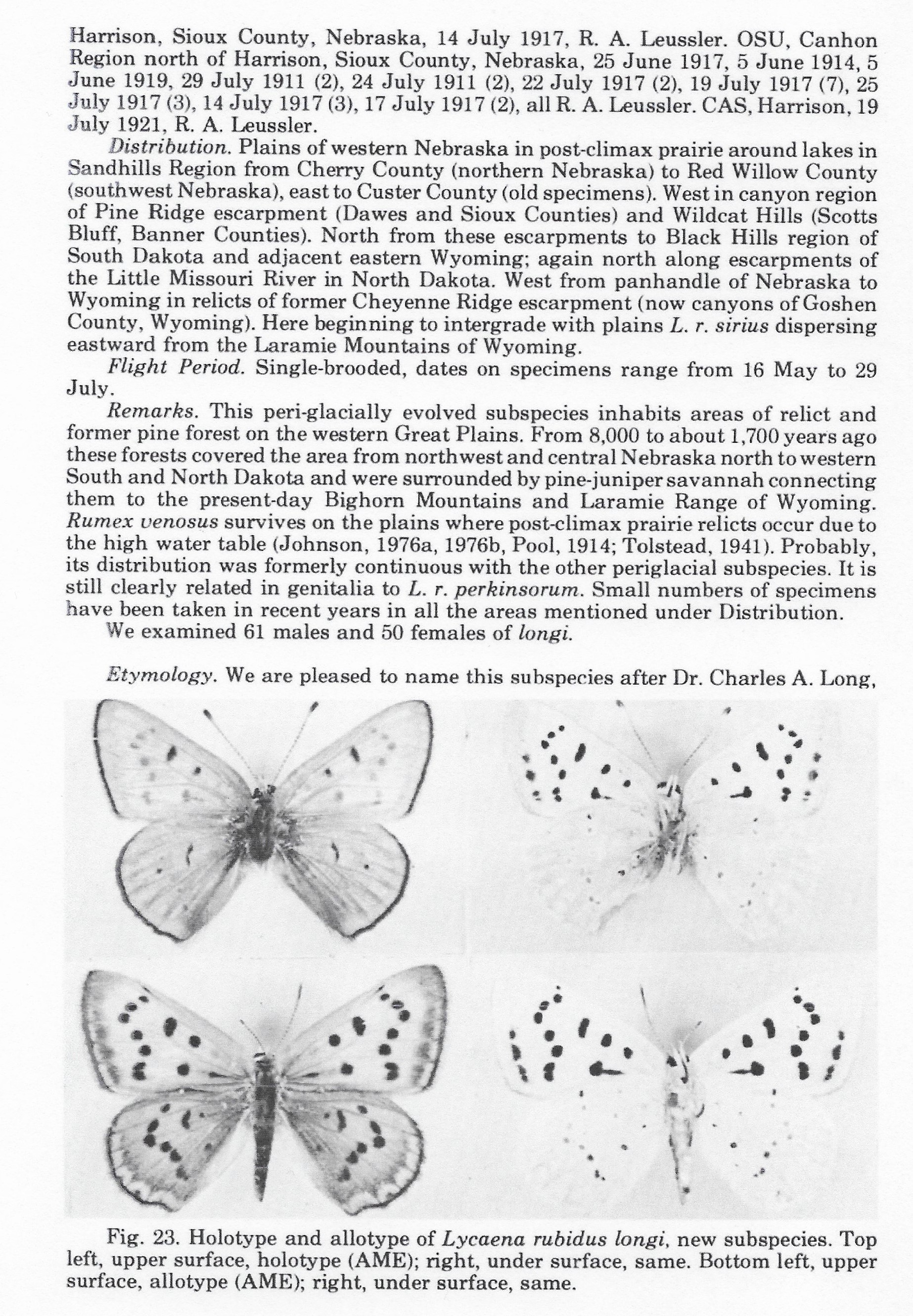
This butterfly (Lycaena rubidus – the Ruddy Copper) inhabits the western half of the United States but is largely absent from New Mexico, Arizona and southern California. Eastward it can be found into western portions of the Dakotas and Nebraska. In a lengthy review of the species in 1977 Johnson and Balogh described a new subspecies (Lycaena rubidus longi K. Johnson & Balogh, 1977) from Nebraska, again with the type locality being “the region north of Harrison” in Sioux county. A holotype (single type specimen) is housed at the McGuire Center for Lepidoptera and Biodiversity in Gainesville (University of Florida). This area north of Harrison is also the type locality for Pahaska Skippers (Jan 8 post) and Bernadetta Checkerspots (Feb 23 post). See the Jan 2 post for the type locality discussion.

Lycaena rubidus longi thumbnails (butterfliesofamerica.com)

There is one generation of Ruddy Coppers annually, generally lasting a couple of weeks with numbers peaking in mid June. As with all coppers, larvae feed on docks (Rumex species), with this butterfly showing a preference for winged dock aka wild begonia (Rumex venosus) which is widely distributed in western Nebraska.

Butterflies with Type Localities in Nebraska – Smoky Eyed Brown – Lethe eurydice fumosus (Leussler 1916)

This is another butterfly Richard Leussler (that man again – see Jan 8 post) named, this time as a subspecies. The name he originally gave the butterfly was Satyrodes canthus n. v. fumosus but the genus was later changed to Lethe and the species to eurydice. So the current name is Lethe eurydice fumosus (Leussler, 1916). The type locality is listed as “Sarpy County, south of Omaha, Nebraska”, probably near present day Fontenelle Forest.

This species is an inhabitant of wetlands, marshes and low lying riparian habitats. The Nebraska Natural Heritage Program has this butterfly listed as a Tier 1 species (see June 14 2020 post). It flies in a single generation each year from late June through mid July. Larvae feed on various sedges. Last year I found it in abundance along Victoria Creek below Victoria Springs State Recreation Area in Custer County (see June 28 2020 post) and again at marshy/riparian areas at the Niobrara Valley Preserve in Brown and Keya Paha Counties. Jon Nikkila found and photographed others at the North Loup River just north of Brewster in Blaine county (photo above) and Smith Falls State Park.

Click on the link below to see the actual type specimens. They are in amazing shape for being over 100 years old. Properly cared for pinned specimens (kept out of light to prevent fading, kept dry to prevent bacterial/fungal decomposition and fumigated to prevent dermestid beetles from eating them) can theoretically last forever. Or at least 100 years.

Lethe eurydice fumosus (type specimens) (butterfliesofamerica.com)

Lastly here is the latest updated distribution map of the Smoky Eyed Brown in the state of Nebraska.

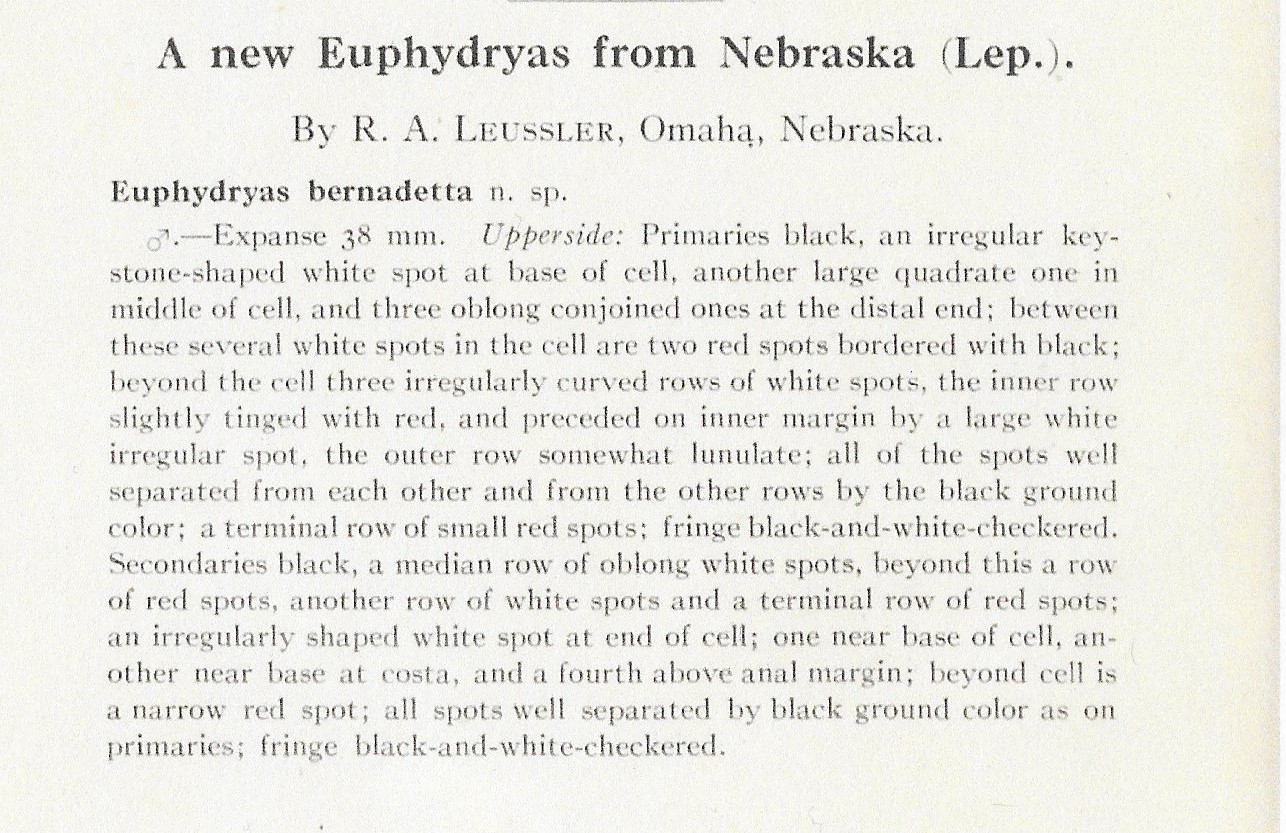
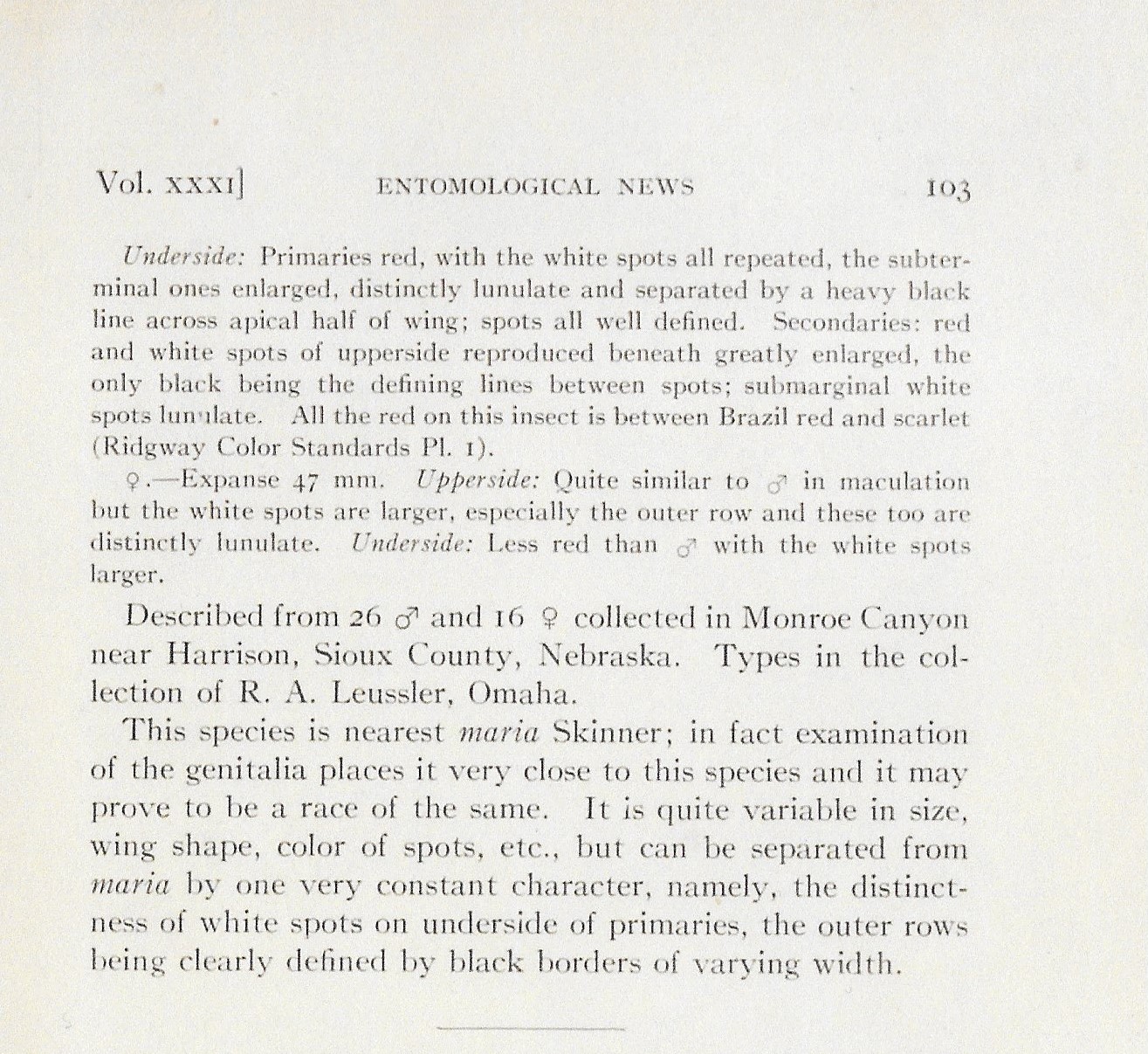
Butterflies with Type Localities in Nebraska – Bernadetta Checkerspot (Euphydryas anicia bernadetta)

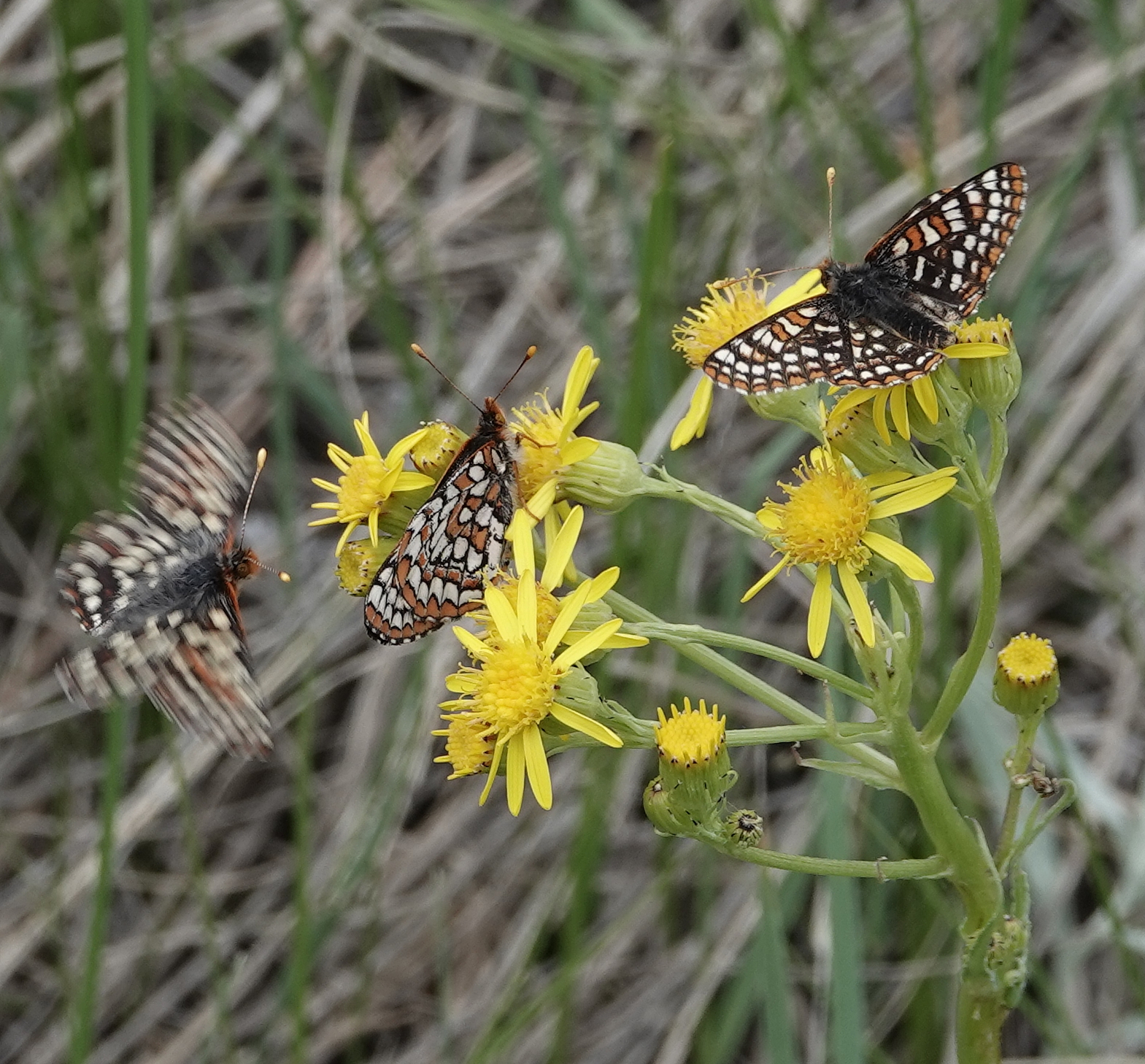
Staying on the theme of butterflies with type localities in Nebraska, back in 1920 Richard A Leussler (that man again – see Jan 8 post) described what he believed to be a new species of Checkerspot which he called Euphydryas bernadetta. In the years since the powers that be have decided that it is actually a subspecies of Anicia Checkerspot and relegated bernadetta to a subspecies. (Euphydryas anicia bernadetta Leussler, 1920) The Anicia Checkerspot is found in the western United States, with bernadetta being the eastern most subspecies, residing in Nebraska’s Pine Ridge and South Dakota’s Black Hills. Mr. Leussler described the subspecies from a series of specimens (syntypes) he collected in Monroe Canyon in Sioux County. These specimens are housed at the Ohio State University invertebrate collection.

This butterfly flies in a single spring flight, usually in May. It can be abundant. The Monroe Canyon type locality is now a Nebraska Game and Parks property (Gilbert-Baker State Wildlife Area).

Anicia Checkerspot Euphydryas anicia (Doubleday, [1847]) | Butterflies and Moths of North America

Butterflies with Type Localities in Nebraska – Nebraska and Kohler’s Fritillaries with an updated distribution map

Let’s revisit a theme from the Jan 2 post (butterflies with type localities in Nebraska). The Silver-bordered Fritillary (Boloria selene) currently has eight named subspecies spread across the northern half of the United States. Among these eight two are named from type localities in Nebraska. The first B. selene nebraskensis (W. Holland, 1928) was named from specimens from Dodge County, Nebraska. Mr. Holland described this subspecies from four males given him by E. A. Dodge. His justification for elevation to a new subspecies was that they were larger (by some 25%) than eastern specimens (subspecies myrina). A lectotype (type specimen designated later) is housed at the Canadian Museum of Natural History in Ottawa, Ontario.

The other subspecies with a Nebraska type locality is Boloria selene sabulocollis Kohler, 1977. Sabulocollis is Latin for “sand hills”. This subspecies was described from specimens found at Smith Lake, Sheridan County, Nebraska, in Nebraska’s sand hills region. Mr. Kohler believed this population deserved designation as a subspecies on the basis that the median black lunules of the ventral hindwing are “square shaped” rather than oblate and elongated. A holotype (actual type specimen) is housed at the American Museum of Natural History. in Manhattan, NY.

In Nebraska there can be considerable variation within a population at any given locality. As you can see the two subspecies are rather weakly differentiated (my opinion). Perhaps the differences are clearer to you. But that’s what taxonomists do.

Nebraska Game and Parks has both subspecies listed as tier 1 in the Nebraska Natural Heritage Program (see the June 14 2020 post). Last year I found this butterfly near Worms (July 6 post), at the Niobrara Valley Preserve (August 31 post) and at a wetland north of North Platte.

This butterfly inhabits marshes/wetlands and is triple brooded in Nebraska with spring, mid and late summer flights. In Nebraska it is largely restricted to the the Platte River valley and marshy areas to the north, often near riparian areas associated with the Niobrara, Dismal, Calamus, and Loup Rivers as well as sand hills marshes. One notable exception is a single specimen taken by Austin Joy from a moist dale at Cather Prairie south of Red Cloud (Webster County) on a UNK field trip. Had I not been there that would have been another record I would have had a hard time believing.

Silver-bordered Fritillary Boloria selene ([Denis & Schiffermüller], 1775) | Butterflies and Moths of North America

Found one time in Nebraska – The Hermit (Grais stigmaticus)

On 9/20/2005 Doug Long found another butterfly (skipper actually) in the state for the first time. This time is was a Hermit (Grais stigmaticus) which he found near Holbrook in Furnas County. While certainly not the most colorful “butterfly” in Nebraska (many people would have mistaken it for a moth) Doug alertly noticed the yellow coloration on the bottom of the head and thorax. The Hermit is a tropical species, occasionally straying into the United States. Doug’s Nebraska specimen is the northern-most in the continent (there are two records from Kansas, one from Oklahoma and a dozen or so from Texas). After Doug’s passing the specimen was donated to the Henry Doorly Zoo by his wife.

A quick note on separating butterflies, skippers and moths. While there are other differences a check of the antennae will quickly differentiate the three. Butterflies have “clubbed” antennae (a “club” at the terminus), skippers, while their antennae may be thickened at the end, lack a club and are “hooked” instead (see above). Moth antennae are neither of the above. Their antennae may take various shapes (including threadlike or hairy).

Hermit Skipper Grais stigmaticus (Mabille, 1883) | Butterflies and Moths of North America