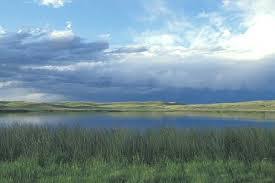
Back on May 2 1989 I was looking to get outside for a spring butterfly outing. Harlan County Reservoir was just an hour away so off I went. I parked in the lot at the south end of the dam and started checking the chokecherry, lilac and aromatic sumac flowers which were all in bloom. I found a nice variety of butterflies including Juniper Hairstreaks, Wild Indigo Duskywings, and Olympia Marblewings. Somewhere in the course of the afternoon I caught a small non-descript skipper. After returning home and pinning it up I was unable to identify it. After Dr. Ray Stanford of Denver (an expert on western species) passed on making an id I was really curious. I passed the specimen on to Steve Spomer at UNL who in turn circulated it to his circle of “experts”. It ended up being a female Cobweb Skipper (Hesperia metea) which had never been found in the state before. The Cobweb Skipper is primarily southeastern in distribution, flying in the spring. It’s larvae feed on bluestem grasses. There are several Kansas records but the Harlan County Nebraska record is the northwestern most in the continent. Over the past 30 years the Harlan County spring trip has become an annual event. Two other times I think I have spotted Cobweb Skippers but the the critter is so small and indistinctly marked I can never be sure. I’m unsure as to whether to specimen blew in or is a resident in the state. One of Steve’s experts related that this species is somewhat of a homebody, not straying far from its breeding habitat If a resident it’s early spring flight time would explain it’s paucity of records. It should be watched for on/near native prairies in the southeastern portions of the state in the spring. The skipper was donated to the UNL insects collection.
On June 24 1989 Jim Reiser and myself were out on Nebraska Highway 2 in Sheridan County (2 miles west of Ellsworth). We had found a colony of Ruddy Coppers (one of the more striking butterflies in the state) taking nectar from dogbane along the Burlington Northern railroad right of way. At some point Jim showed me an odd hairstreak he had captured. I did not recognize it either and my attention span moved on to other matters and I quickly forgot about it. So after Jim returned home he pinned up his hairstreak and, still not feeling good about making an id, ended up sending a pic to Dr. Ray Stanford for his opinion. Ray was amazed (as were we). It was a Leda Hairstreak which is a resident in the American southwest where it’s larvae feed on mesquite flowers. The next nearest record was in the Texas panhandle some 500+ miles away. And the butterfly (pictured) is in amazingly good shape. I would not expect another to ever be found in the state. I was there and I’m still not sure I believe it. Congratulations Jim!!
On July 18 1993 Doug Long found another butterfly never before recorded from Nebraska. In Holbrook (I assume in his yard) he found this Mimosa Sulphur (Pyrisitia nise). I likely would not have given it a second look and passed it off as a Little Yellow (P. lisa). As a small (more “delicate”) butterfly and a stray from its normal range in southern and southwestern United States it is extremely worn. While it was probably assisted by a tailwind it is still amazing how far insects can travel. There are about a dozen records of this butterfly from Kansas but only the Doug Long specimen from Nebraska. This specimen (and many others) was donated to the Henry Doorly Zoo by his family after his passing.
Every year I compile a Season Summary to submit to the Lepidopterists’ Society highlighting new county/state records for butterflies, new moth species for the state and anything other interesting finds. I’ll briefly summarize what I reported this year.
2020 turned out to be a pretty good year diversity wise. Roughly a dozen observers recorded 113 butterfly species from the state which I believe to be the highest recent one year total. In spite of that there were only seven county records. There were some good finds including the second record of M Hairstreak, from Fontenelle Forest (Joanne Langabee) a Satyrium caryaeovorum record (one of only a handful) from Steve Spomer, and a Speyeria callippe record (first since 1997?) from Dr. Brust in the Pine Ridge. Northern Pearly Eye’s were a little more common than usual. There were also notable absences including Papilio bairdii, Pontia sisymbrii and Chlosyne fulvia. There were a few southern strays recorded but nothing widespread or overly abundant.
County records included Sachem Skipper – Sioux County (Jonathan Nikkila), Hobomok Skipper – Lincoln County (Neil Dankert), Giant Swallowtail – Butler County (Jeri Glenn), Ruddy Copper – Garden County (Neil and Jennifer Dankert), Snout Butterfly – Franklin County (Neil and Jennifer Dankert), Northern Pearly Eye – Saunders County (Lori Tomes), and Queen – Garden County (Neil and Jennifer Dankert).
Three dedicated reporters added 28 new moth species to the state list bringing that total to 1347. Moth reporters are special people and deserve some recognition. I’ll try to highlight some of their finds in later posts.
For a list of butterflies found in the state (last year or from the beginning of time), or from any county contact me at nebraskabutterflies@gmail.com. I’d also be happy to send you the moth spreadsheet.
On October 26 1996 Doug found this butterfly in his backyard in Holbrook NE. If I recall correctly he said it was on a watermelon rind he had left in the garden to attract butterflies. Well I guess it worked. Most people (myself included) would have thought “Hey, that’s interesting, a Goatweed Butterfly”. (The Goatweed Butterfly is widespread but somewhat uncommon in Nebraska). But not Doug. Recognizing it was not a “typical” Goatweed he collected the butterfly and sent the pics off to Drs. Ray Stanford and Paul Opler who verified it was a Tropical Leafwing form “trogolodyta” The Tropical Leafwing is a resident in southern and western portions of the United States and then into Mexico. There are several records from Kansas but Doug has the only Nebraska record of this southern stray. Tropical Leafwing Anaea aidea (Guérin-Méneville, [1844]) | Butterflies and Moths of North America.
For comparison purposes the more common Goatweed (of which there are multiple forms) is illustrated below.
Back in my student days at Kearney State College the Biology Department sent out newsletters to high school Biology teachers. My academic advisor (Dr. Harold Nagel) had an idea to send out solicitations for students/teachers interested in contributing specimens/data on Lepidoptera species. One of the responses we got was from one of Doug Long’s kids. The Long family lived in Holbrook (Furnas county) where Doug had grown up and returned to after attending UNL. By the 1980’s Doug and his brother were operating a local garage/gas station along with selling fertilizer. But Doug had always had an interest in butterflies since childhood and was always on the lookout for anything new.
So after a few phone calls Dr. Nagel arranged for he and I to meet Doug at his house in Holbrook. At that time my knowledge of butterflies was somewhat limited and for Dr. Nagel it was another of the wide ranging variety of topics which were peripheral to his specialty (soils, botany, ecology, et al). In hindsight I guess we probably thought we knew a little more about butterflies than we did. So we “experts” showed up at Doug’s house not really knowing what to expect. We were certainly not prepared for what we encountered. Doug began pulling out Riker mounts full of butterflies that he had collected locally over the years. Some of which these we had never seen in Nebraska before as well as things we considered rare but of which he had dozens of. By the time we left several hours later our heads were spinning. So began a twenty year friendship.
Lets put Doug’s work into perspective. In 1986 Dick Rosche published a set of distribution maps that listed 15 species from Furnas County. That was before we had visited Doug’s house. After that visit Furnas County had 65 species. That was roughly equal to the number of species found in Buffalo county – the county where I resided and with many more observers. So for a while it turned into a friendly competition as to which of us could outdo the other. That was only for a while. By the time we put out a new set of maps in 1993 Doug had Furnas county bumped up to 87 species while we here in Buffalo county trailed with 76. By 2005 that lead had grown to 106 to 85. I used to joke with Doug that every southern stray entering the state had to come through Furnas county and get by him before anyone else had a chance to see it. And it seemed he didn’t miss many. As a lifelong resident he was known to everyone and knew of and had access to every nook and cranny of habitat in the area. If I put him onto a butterfly associated with a certain plant flying at a certain time he almost invariably would find it, often at multiple locations.
Occasionally I had opportunities to collect with Doug. One day we went out to look at a pasture where he had discovered a state record (Polites carus). As we got into his pickup he quizzically asked if that was what I was wearing into the field (jeans, t-shirt, sneakers and cotton socks) which was my usual attire. He never said anything but I could tell he was somewhat amused when I spent the rest of the day in obvious discomfort picking cheatgrass out of my shoes and socks while he emerged unscathed in his leather work boots. That afternoon aside I always enjoyed any time I got to spend with Doug and we bounced ideas and discoveries off each other for 20+ years.
Sadly Doug unexpectedly passed away in January of 2008. His wife Sandy donated his display collection of Riker Mounts to Henry Doorly Zoo and his extensive collection of papered specimens to me. By the time of his passing he had bumped Furnas county up to 110 species. Buffalo County is at 88 species – I guess Doug is giving me a chance to catch up. Furnas county’s 110 species ranks third behind the Pine Ridge counties of Sioux and Dawes which have had the attention of collectors for over a century and ahead of Douglas county with it’s 100 year history of numerous observers.
One humorous anecdote – Dr. Ray Stanford is an avid lepidopterist who for quite some time resided in Denver. His avocation was to find butterflies where they had not previously been found (county records). Ray would map out trips based on areas with a paucity of records. Ray made numerous raids into Nebraska, visiting areas we locals lacked the time or inclination to visit. He once wrote to me that he drove up to the Furnas county line “to see what the Garden of Eden looked like”, took in the view and then left as there were no new butterflies to be discovered there. I never got a chance to tell that to Doug but related that story to his wife Sandy after his passing. She thought that Doug would have gotten a chuckle out of that.
Doug found numerous amazing state records in Furnas county over the years. I’ll be highlighting some of them in upcoming posts. Stay tuned!!
It is of interest that while Richard A Leussler was/is perhaps Nebraska’s most noted Lepidopterist, that was not his vocation. While I was unable to find out much about his early years he was evidently born in St Louis in 1866 and came to Nebraska in 1902 as an executive in the Omaha and Council Bluffs Street Railway Company which ceased operations in 1955. His work also took him into leadership jobs with steel and bridgework companies. He passed away in Omaha on August 22, 1943.
But he is perhaps most well known for his work as an amateur lepidopterist. During his time in Nebraska he published nine scientific papers (the most notable being a statewide compilation published in 1938 which listed 159 species) and described one new species and four new subspecies. His collection of 3476 specimens is now housed at Ohio State University. Mr. Leussler made numerous trips across the state which would likely have been quite an adventure with the state of roads at that time.
The new species Mr. Leussler described from the state is Hesperia pahaska (Leussler, 1938). In 1938 in the Entomological News he wrote: “On the high plains of the canyon region in Sioux County, Nebr., there flies a skipper which has passed under various names but which differs from all named forms. An examination of the genitalia indicates that it is distinct. I propose for it the name pahaska, the name the Sioux Indians bestowed upon Col. Wm. F. Cody (Buffalo Bill) who killed Chief Yellow Hand in single combat in War Bonnet Canyon, upon the rim of which this skipper flies. “Pahaska” in the Sioux language means “White Chief”.”
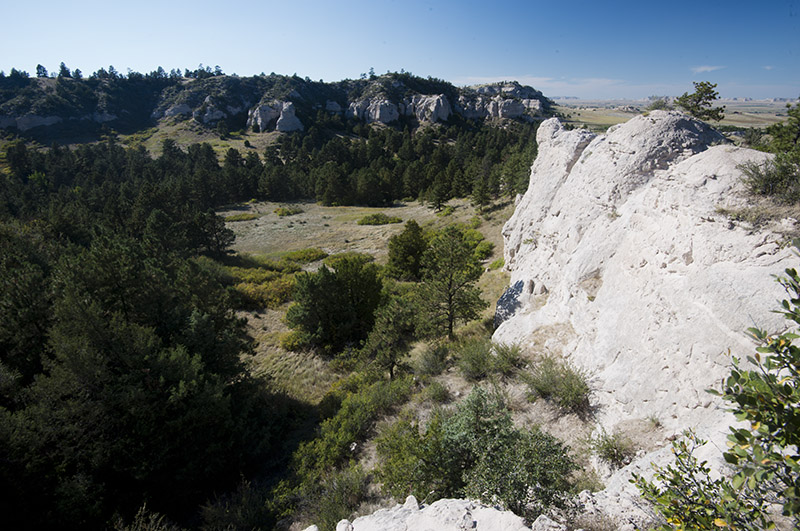
So this is a butterfly first discovered and described in Nebraska with “the high plains of the canyon region in Sioux County, Nebr.” being its type locality. The type specimens are in the Triplehorn invertibrate collection at Ohio State University. Today War Bonnet Canyon is on private land and to my knowledge has not been visited recently. Of late the Pahaska Skipper has been difficult to locate in the Pine Ridge area. I did manage to find one in Kimball county south of Interstate 80 mm1 last year (see June 26 2020 post). It flies once a year from late May into July. It’s larvae feed on short to mixed grass prairie grasses.
Pahaska Skipper – photo from BugGuide.netRange of Pahaska Skipper in Nebraska
Additional specimens can be viewed by utilizing the following link.
Hopefully this post finds everyone healthy and well. So we made it to 2021 but it’s still not butterfly season. So to pass the time (and as time permits) I’ll try to put together some interesting tidbits on Nebraska butterflies and the people who have worked with them to share with you. I hope you enjoy them.
Carl Linnaeus
Back in the day (1700s) Carl Linnaeus came up with binomial nomenclature to name living organisms. This consisted of giving every type of living thing a genus and species name with the genus being a group of related organisms and the species being specific to one life form. Kind of like your name except your last name would come first. From there scientists started naming every living thing they found.
A complete binomial name includes the author (scientist naming the organism) and the date he named it following the binomial name. For instance the Monarch butterfly was named by Linnaeus in 1758. He called it Papilio plexippus. Later taxonomists changed the genus name to Danaus. Taxonomic rules (and there are a lot of them) require the author and date be placed in parenthesis if the genus name has changed from the original. So today the Monarch is known as Danaus plexippus (Linnaeus, 1758).
Now that most butterflies have been named lepidopterists are getting restless and amusing themselves naming subspecies which may (or may not) have observable differences from the type specimens. Some scientists have been going down to the molecular level and finding previously undiscovered ancestral links and changing some long used genus names. This distresses me greatly. It’s like if someone you’ve known your whole life changes their name!!
Type specimens and Type Localities – In a separate but related topic, for every new species described the scientist has one (a holotype), or a set of (syntypes) specimens on which they based their description. These are referred to as type specimens and are typically preserved in museums or institutions of higher learning. The location where the type specimens were collected then became the type locality.
There is often a story behind a name. One I find fascinating (OK I’m weird) is Speyeria carolae (dos Passos and Grey, 1942). The butterfly was named after Carole Lombard who died in a plane crash near the type locality just outside of Las Vegas on Jan 16, 1942 (google that story). The butterfly was named later that same year from a type locality near the crash site and was originally named as a subspecies of the Coronis Fritillary Argynnis coronis carolae. The genus was later changed to Speyeria (so the authors and date were placed in parenthesis) and then later the subspecies elevated to full species status. So we end up with Speyeria carolae (dos Passos and Grey, 1942). The area (Red Rock Canyon) is a rugged mountainous park just west of Las Vegas. Someday I will go to Vegas in early summer when it flies and go look for it. Who will believe I’m going to Vegas to hunt for butterflies?
Other scientists name a butterfly after a person. One is Papilio joanae J. Heitzman, 1973 (The Ozark Swallowtail) that was named after the author’s wife Joan. Talk about raising the bar!! Or a more humorous one – the subspecies Chlosyne nycteis pastoron Pellham, 2008 (type locality in North Carolina) was named for Pastor Ron Gatrelle who is a noted amateur lepidopterist in southeast United States.
Still others have named species/subspecies for geographic features where the type locality is located. The subspecies Papilio indra panamintensis J. Emmel, 1982 is named for the Panamint Mountains in Death Valley, the type locality for this subspecies and Boloria selene sabulocollis Kohler, 1977 where sabulocollis is Latin for sand hills.
Other names come from Greek mythology such as the Aphrodite Fritillary – Speyeria aphrodite (Fabricius, 1787) named for Aphrodite, the Greek goddess of love or Indian chiefs like the Mulberry Wing Poanes massasoit (Scudder, 1864) named for Massasoit, a Wampanoag Indian chief who was hospitable to the Plymouth colony.
If you’ve read this far you must be curious as to where this is going. There are two species and eight subspecies of butterflies have type localities in Nebraska. I thought it might be interesting to look at these and some of the scientists who named them. As this is to many to cover all at once I’ll sprinkle them in from time to time.
So I guess with snow and temps in the teens that butterfly season is officially over. Despite late season trips to the North Loup, Niobrara and Republican Rivers I’ve been stuck on 102 species since just before Labor Day. So 102 species it is. That exceeds what I expected thanks in large part to my wife Jennifer, Jon Nikkila (along with his sons Bennett and Henry) and Pat and Dianne Miller all of whom aided/abetted my effort. Many eyes proved to be better than my two. I would not have reached 102 species without them. I will take credit for selecting the sites. Some of them I discovered myself but once again many of them were handed down to me from previous collectors. So thanks to them (to numerous to mention) as well.
Over the course of the year I encountered 7 butterflies listed as Tier 1 species by the Nebraska Natural Heritage Program along with another 38 Tier 2 species. Once again, see the June 14 post for a brief summary of the Nebraska Natural Heritage Program. The Tier 1 species are denoted by bold type below while the Tier 2 species are italicized. I also ended up finding four county records in 2020, these being Hobomok Skipper (Lincoln Co), Ruddy Copper (Garden Co), Snout Butterfly (Franklin Co) and Queen (Garden Co). One of the downsides of the “Big Year” was that I did very little exploring – mostly just revisiting sites where I’d found butterflies before. I haven’t yet decided on next year’s project but it will almost certainly involve more exploring.
The list below denotes where I made the first sighting of each of the 102 species in 2020. Many species were sighted multiple times, but are only listed in the locality where I first found them. Thus the locations I visited earlier in the year will have more species found there. So a lower number of species at a location does not necessarily indicate a less desirable habitat but more likely that there were fewer butterfly species “available” to be found.
Box Elder SWMA (April 11, May 3, May 20, July 5) – 12 species: Common Sootywing, Crossline Skipper, Hobomok Skipper, Dusted Skipper, Yucca Giant Skipper, Black Swallowtail, Olympia Marble, Clouded Sulfur, Gray Hairstreak, Silvery Blue, Variegated Fritillary, Gorgone Checkerspot
Box Elder SWMA – The Bennett and Henry Nikkila at work looking for yucca skipper hibernacula
Elm Creek (home)/Sandy Channel SRA – 10 species: Common Checkered Skipper, Sachem, Cabbage Butterfly, Alfalfa Butterfly, Cloudless Sulfur, Sleepy Orange, Reakirt’s Blue, Question Mark, Painted Lady, Monarch
Garden County Refuge – Visitgardencounty.comGarden County Refuge – Visitgardencounty.com
Ash Hollow SHP (June 13, August 22) – 4 species: Western Branded Skipper, Pawnee Skipper, Dainty Sulfur, Marine Blue
Windlass Hill at Ash Hollow State Historical Park. The slight notch in the hilltop and depression beneath it are remnants of the Oregon Trail. Habitat for Pawnee and Western Branded Skippers. Photo by Jonathan Nikkila
Harlan County Reservoir, Cedar Point area (May 5) – 4 species: Wild Indigo Duskywing, Juniper Hairstreak, Pearly Crescent, American Painted Lady
I-80, mm1 exit (June 26) – 3 species: Uncas Skipper, Pahaska Skipper, Western Green Hairstreak
pine bluffs wyoming area, several miles from mm1 site
Crescent Lake area (June 13) – 3 species: Ruddy Copper, Mourning Cloak, Viceroy
I
Victoria Springs area (June 28) – 3 species: Acadian Hairstreak, Eyed Brown, Common Wood Nymph
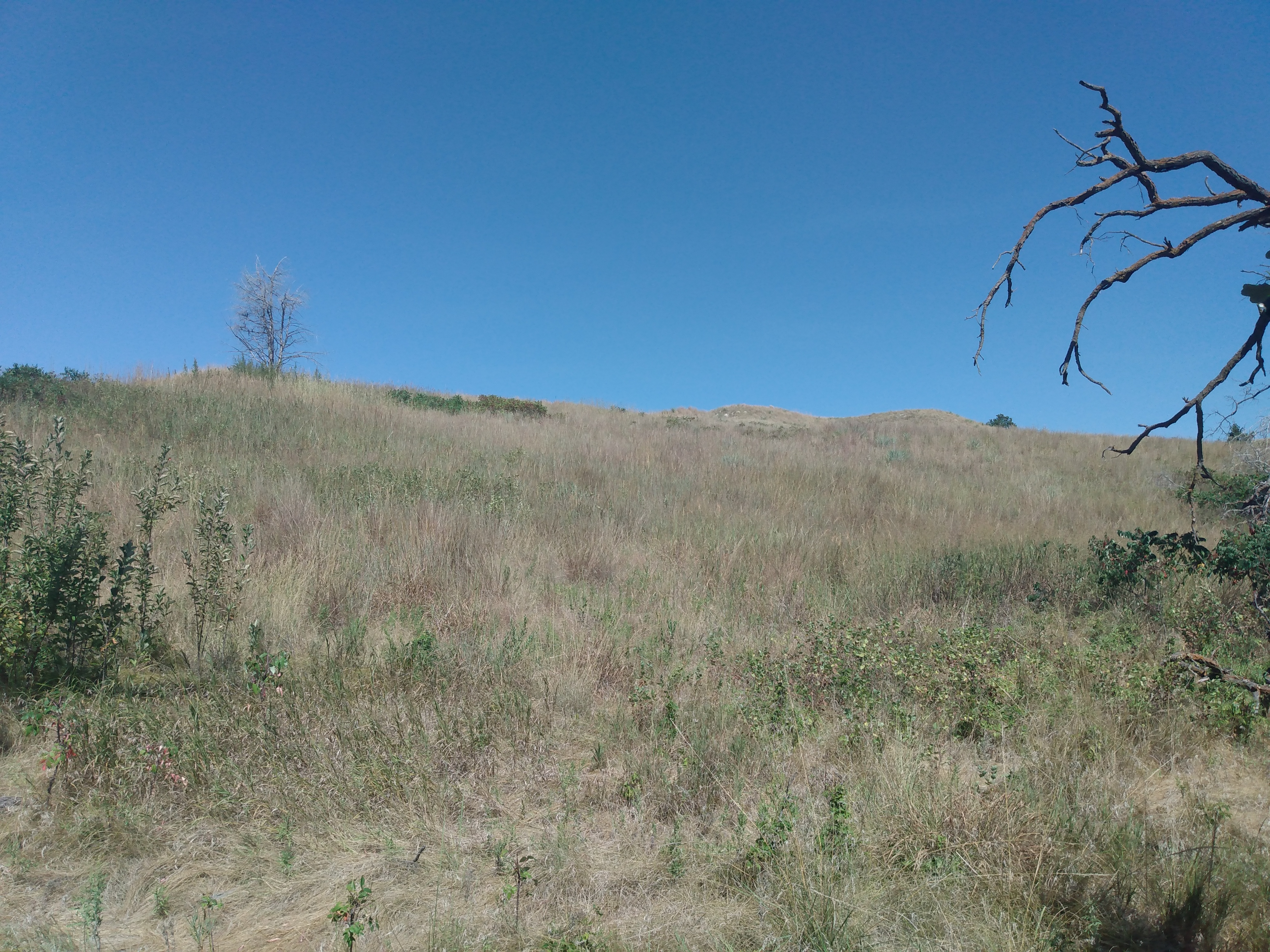
Last September 3 Jen and I met with Chris Helzer and his fellows at the NVP to look for Pawnee Skippers which we found. In addition we found one Lupine Blue and several Horace’s Duskywings. The latter two species had eluded me so far this year so Saturday I made a trip up to the Preserve to try to locate them for my Big Year effort. Thankfully a “cold” front moved through Friday and knocked the temps back about 10 to 15 degrees. With a cooler than normal morning I left a little later than normal and arrived there about noon. First stop was the hill where we had located Pawnee Skippers and the Lupine Blue last year. As is the case in much of Nebraska the plants were starting to show the effects of the heat and lack of rain. The gravely hill doesn’t look like much but its amazing how life holds on there. Once at the hilltop I found some Liatris in bloom and sure enough there were the Pawnee Skippers (Hesperia leonardus pawnee) – albeit only a few.
Pawnee skipper butterfly on curly cup gumweed (Grindelia squarrosa). The Nature Conservancy’s Niobrara Valley Preserve, Nebraska
Male Pawnee Skipper – photo by Jonathan Nikkila
Hesperia hill – Niobrara Valley Preserve
A lot of the Liatris in the area was yet to bloom so that probably made spotting a little tougher. This is the same hilltop where we found the male Ottoe Skipper (Hesperia ottoe) in July (the first sighting in Nebraska in 8 years). The larvae of both skippers feed on native grasses including little bluestem. What a hardscrabble existence! I’m always happy to find any of the skippers in the genus Hesperia. True native prairie specialists, they survive in some harsh looking environments and finding them always gives me hope that all is not lost. Unfortunately while finding skippers I was unable to locate any Lupine Blues.
The next stop was Middle Creek where I’d noticed a few Purple Loosestrife blooming by the culvert. They were covered with scores of cabbage whites while a thistle in the creekbed had attracted some regal and great spangled fritillaries. The fritillaries were females coming out of a mid summer period of inactivity to refuel before laying eggs from which larvae will hatch and overwinter. But no Lupine Blues or Horace’s Duskywings there either.
Regal Fritillary – photo by Jonathan Nikkila
Great Spangled Fritillary – photo by Jonathan Nikkila
So I moved on to what last year was a thistle and purple loosestrife patch east of the HQ area where I had seen several Horace’s Duskywings last year. TNC had managed to knock the thistle population back to near zero but Purple Loosestrife was still abundant. There I found Eastern Tailed Blues and Tawny Edged Skippers to be abundant as well as some Checkered Skippers, Silver Spotted Skippers and Gray Hairstreaks. But the best find of the day was sighting a few Silver Bordered Fritillaries which had also been there the year before. But still no Horace’s Duskywings.
Tawny Edged Skipper
Checkered Skipper
Eastern Tailed Blue
Silver Bordered Fritillary – photo from bugguide.net
Grey Hairstreak – photo by Jonathan Nikkila
My last option was a leg of the hiking trail from the Fairfield Creek Road that ran along a spring fed rivulet back into the oak woodland. Along that small stream there were several thistles and some Joe Pye Weed in bloom on which there were several Giant Swallowtails. An anglewing (Polygonia sp) was also in the area as well as a few Monarchs.
Giant Swallowtail – photo from chicago.suntimes.com
Having exhausted my best options on the Preserve I headed back south with some time to kill. So I took a new road less traveled from Brewster to Milburn to Gates to Broken Bow, stopping to take a pic of the lone building remaining in Milburn – the Milburn Hall (1911) (note the outhouse in the lower right).
Milburn NE – population 0
So while I was disappointed not to have found any new species for the big year it was a great day for a drive and some hiking around – sunny, temps topping out in the mid 80s with less wind than normal. I got to see Pawnee Skippers, Silver Bordered Fritillaries and Giant Swallowtails which doesn’t happen every day. I’m still at 102 species for the year with my options dwindling. But a great day anyway!
Continue sending your photos to NebraskaButterflies@gmail.com and we’ll do our best to get them posted on our images page. Thanks for your time and interest!!