If it’s not to late and you haven’t already purchased all your plants for the year you might consider some plants that attract and sustain our native butterflies and pollinators. There are several great resources for our state. The first is a NebGuide by Steve Spomer and Kim Todd titled “Butterfly Gardening.” It is available online at http://extensionpublications.unl.edu/assets/html/g1183/build/g1183.htm or at your local extension office. The second is a guide/application for a pollinator garden which is at https://entomology.unl.edu/pollinatorapp.pdf. Between the two they will assist you in finding plants for your property that will help our insect friends survive in our ever changing world. The only addition I might have is Rue (Ruta graveolins) which in my yard has proved extremely hardy and serves as a larval hostplant for both Black and Giant Swallowtails.
Rue – Ruta graveolens
I would encourage planting species native to this area (other than rue of course) as they should require little care and are familiar to the native insect fauna. Had I to start my prairie garden over I would take the Nature Conservancy approach and gather local seeds and start from there. But alas at this late stage I just buy “native” potted plant species, sourced locally if possible. As the Nebraska Statewide Arboretum is closed with the rest of the UNL campus I will not endorse any one particular nursery over another. I will leave that to all of you in the comments section.
Happy gardening – (here is a picture of a butterfly milkweed from a Pawnee County road ditch). My screen saver and something I aspire to have in my yard someday
In Nebraska there are three Duskywings whose larvae feed on oaks, these being Juvenal’s (Erynnis juvenalis), Horace’s (E. horatius) and Sleepy (E. brizo). Two, Juvenal’s and Sleepy, fly only in the spring while Horace’s has three flights – spring, mid and late summer. They rarely stray far from oak trees and so their distribution in the state largely matches that of native oaks. True to their name they are brown/black in color. Juvenal’s and Horace’s are medium sized while the Sleepy is about half their size. Juvenal’s and Horace’s Duskywings are extremely difficult to separate in the field with the best identifying mark being the presence of two lighter spots on the ventral hindwing (as indicated by the arrow).
Top – Juvenal’s Duskywing (Erynnis juvenalis) dorsal and ventral Bottom – Horace’s Duskywing (E. horatius) dorsal and side views
Sleepy Duskywing – Erynnis brizo
Distribution of E. juvenalis in Nebraska
Distribution of E. horatius in Nebraska
Distribution of Erynnis brizo in Nebraska
As mentioned earlier the distribution of these species is limited by the presence (or absence) of native oaks. Public access areas to see these butterflies (skippers actually – hooked antennae instead of clubbed) range from Indian Cave State Park, Twin Oaks SWMA and Table Rock SWMAs in the southeast up to the Niobrara Valley Preserve in the north central part of the state. Large portions of the state with oaks have no records for these three species so there are a lot of possibilities out there.
The season is moving along and I did not see any of these Duskywings on our earlier visit to Indian Cave State Park so another trip to southeast Nebraska is on my agenda next week when the weather warms up since two of these are spring fliers and I don’t want to miss them.
There are three species found in eastern Nebraska – Polygonia interrogationis, P. comma and P. progne. They differ from most other butterflies in that they overwinter as adults and often prefer rotting fruit or tree sap over flower nectar. These three species are quite similar in appearance and while there can be several color phases or forms the descriptions below will be adequate to identify them. While myself not having seen any Polygonia yet this year I have heard that all three have already been sighted this year. So a quick note on this group and how to identify them.
The Question Mark (Polygonia interrogationis) is so named for the silver marking on it’s ventral hindwing. This silver mark is curved with a separate spot underneath it thus forming a “question mark” from which it gets its common and species name. It can also be separated from comma and progne by the presence of a black bar on the upper forewing that the other two lack. It is generally larger than the other two but this is not a reliable trait. The Question Mark usually also has a more elongate profile while the other two appear “rounder”. Larvae feed on a wide variety of plants from elm trees to wood nettles.
The Eastern Comma is also named for the silver marking on its ventral hind wing. It lacks the silver dot beneath the silver “comma” marking from which it gets its name. As with the Question Mark, larvae feed on a wide variety of plants. It is sometimes referred to as the Hop Merchant due to its utilization of hops as a larval hostplant.
Polgonia comma, dorsal and ventral
The silver marking on the Gray Comma (Polygonia progne) is shaped like a kinked straw – straight with a bend in the middle. It gets its name from its more gray shading of the ventral hindwing which is also slightly two toned with the base being darker than the outer portion. It is generally the smallest and rarest of the three, sometimes going unreported for a season or longer. It is also the most selective regarding its larval host plants, laying eggs almost exclusively on Ribes species (gooseberries and currants).
All three of these fly in multiple broods so they might be found at any time. Three times in 30+ years of observations I have hit the trifecta – finding all three species at the same locality on the same day. The first time was at/around Victoria Springs SRA in Custer county on June 30, 1990. The second was somewhere in Webster county on June 17, 2001 when a co-worker took me to his secret deer hunting location to look for Banded Hairstreaks (which we found as well). And then on June 23, 2011 all three were found at Red Fox SWMA in Stanton county.
There are a couple Polygonia species (zephyrus and satyrus) distributed in the western United States that have been found in the panhandle as well. Sightings of these two species are possible (but rare) in the western most counties of the state.
Ever since finding the first and only specimen of the Cobweb Skipper (Hesperia metea) in Nebraska at this site on May 2 1989 I’ve frequently revisited this location trying to recapture lightning in a bottle (or a skipper in a net) but to no avail. But over the years I’ve found quite an interesting mix of butterflies at the south end of the Harlan County Reservoir dam. The location has some Corps of Engineers plantings mixed in with some native plants. The Corps plantings include rows of cedars, honey locusts and honeysuckle interspersed with a few lilacs. Native vegetation includes chokecherry and aromatic sumac. At this time of year the lilacs, honeysuckle, chokecherry and aromatic sumac are all in bloom and attracting butterflies. The Corps has also introduced a vetch into the area that the Wild Indigo Duskywings (Erynnis baptisiae) have taken to as a larval hostplant. So with the abundance of nectar sources and the cedars and vetch this has become my go to spot for Juniper Hairstreaks (Callophrys grynea) and Wild Indigo Duskywings.
So it was with those expectations that I made a solo (sorry, no Jonathan so no cool pics) trip to Harlan County May 5. It was sunny and in the high 60’s but there was a stiff wind from the northwest. Luckily for me my site was on the south side of a shelterbelt and I was largely unaffected by the wind. So I got to spend a couple of hours there before the clouds moved in and shut me down. While not rediscovering the Cobweb Skipper I was able to document 12 species, four of which were new for my 2020 Big Year list. I found (* indicates new for 2020) *Wild Indigo Duskywing (Erynnis baptisiae), Roadside Skipper (Amblyscirtes vialis), Tiger Swallowtail (Papilio glaucus), Marblewing (Euchloe olympia), Alfalfa Butterfly (Colias eurytheme), *Juniper Hairstreak (Callophyrs gryneus), Henry’s Elfin (Callophyrs henrici), Gray Hairstreak (Strymon melinus), *Pearl Crescent (Phyciodes tharos), *American Painted Lady (Vanessa virginiensis), Painted Lady (V. carduii), and Red Admiral (V. atalanta).
Wild Indigo Duskywings are normally difficult to find, but do fly in multiple generations (likely at least three) throughout the summer. Larval hostplants (absent an introduced vetch) would normally be various Baptisia species, and possibly also Lupines and False Lupines. This nickel to quarter sized butterfly does appear to wander a bit as I have had larvae or seen females on the Baptisia in my “urban” prairie garden here in Elm Creek. While not much to look at it is an interesting species that you can find at this site with regularity and also attract to your yard.
Wild Indigo Duskywing – Erynnis baptisiae
Juniper Hairstreak larvae feed on, you guessed it, cedars and other junipers. Adults can be found in a two flights, the first in the spring and a second in late June/July. Adults often perch on cedars and can be spooked/located by tapping cedar branches. It is an small (dime sized) but very attractive butterfly. Perhaps the greatest impediment to sighting this butterfly is just the abundance of cedars. So many cedars to look on. Even with all the cedars available this butterfly rarely is seen in numbers. This trip I saw one. A half dozen is probably the most I’ve seen here where adults seem to prefer aromatic sumac flowers.
Perhaps the most perplexing find was the rediscovery of Henry’s Elfins which were first found there in 2017. In southeast Nebraska this butterfly is normally closely associated with redbud trees, these being their larval hostplants. But Harlan County is hundreds of miles from the nearest redbud tree. A second finding here would seem to indicate a resident population using something other than redbud as the larval hostplant. James Scott (The Butterflies of North America) lists various Prunus species as possibilities. If this is the case in Nebraska this butterfly could occur anywhere. But this Harlan county site is the only spot outside of southeastern Nebraska where this butterfly has been found. Perhaps it goes unnoticed due to its small size, drab coloration and early flight period.
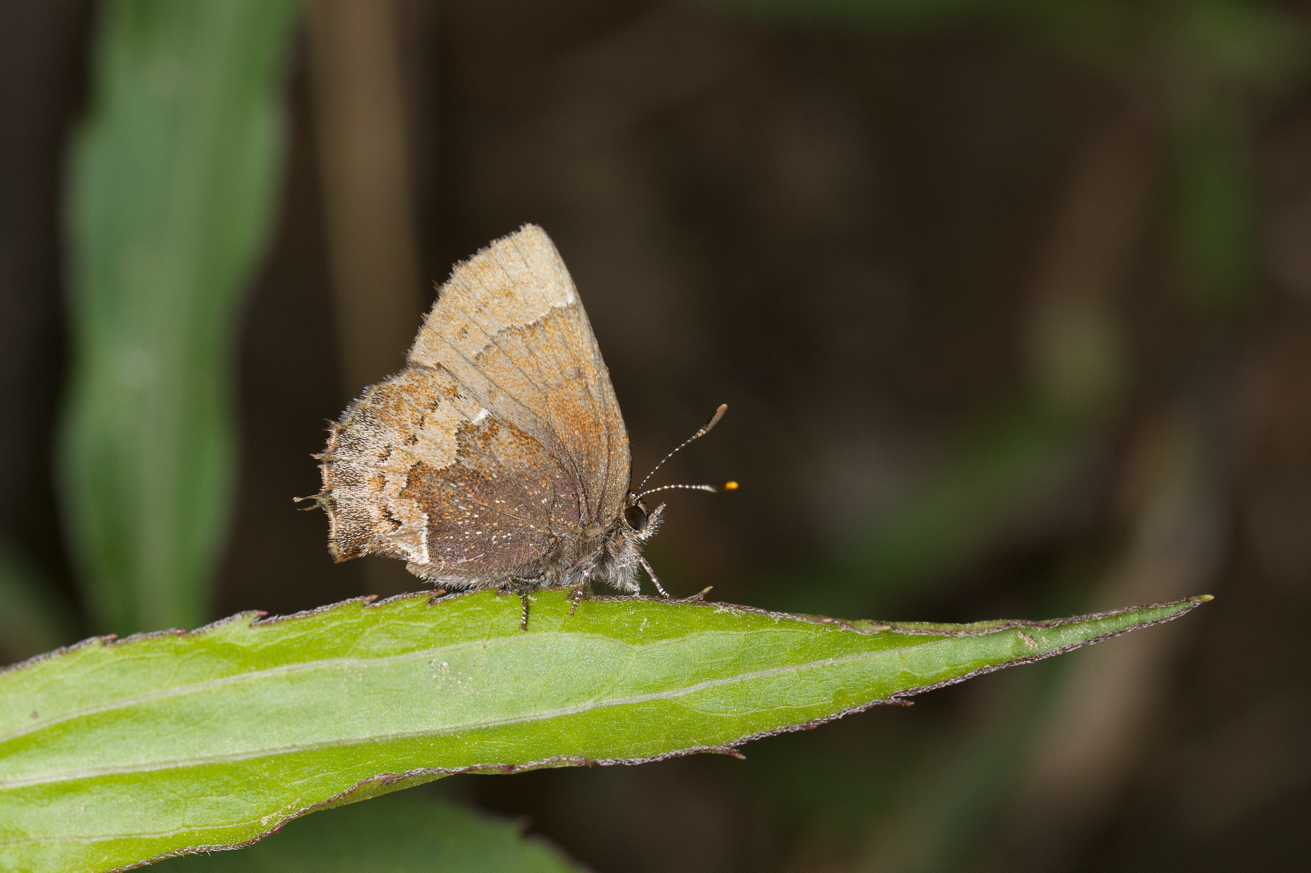
Henry’s Elfin – Callophrys henrici (photo from ICSP)
Olympia Marblewings are still flying and should continue for another couple of weeks before they disappear for the year so there is still an opportunity to get out and see those. We’ve also found Roadside Skippers everywhere we’ve made stops so they should not be to hard to find right now either. And keep an eye out for Henry’s Elfins as well. As always feel free to contact us at NebraskaButterflies@gmail.com with comments, questions, pics and observations.
On May 3 I met Jon Nikkila at Box Elder SWMA in Lincoln county for a second look at this WMA. Our first visit was very early (April 11) and we looked almost exclusively for Giant Yucca Skipper tents (of which we found two) along with one Olympia Marblewing. This trip the main target species was the Fulvia Checkerspot. We were unable to locate that butterfly but should have other opportunities for that species through June. However our visit was not in vain. With a side trip to Jeffrey Canyon SWMA 10 miles to the east six more species were added to the 2020 Big Year list bringing the tyd total to 19 species.
Our best find of the day were Silvery Blues (Glaucopsyche lygdamus) which were almost common at Box Elder. This butterfly can only be found for a couple of weeks in the spring. In Nebraska it had only been found in the panhandle until the 1980s when it was discovered in the loess hills of southwest Nebraska. Subsequent investigations in that area have proved fruitful. In that portion of the state (and at Box Elder) the larval hostplant is slender milkvetch (Astragalus gracilis).
Our sightings for the day were (* denotes first Big Year sighting) Roadside Skipper (Amblyscirtes vialis), *Black Swallowtail (Papilio polyxenes), Tiger Swallowtail (Papilio glaucus), Olympia Marble (Euchloe olympia), *Clouded Sulfur (Colias philodice), *Gray Hairstreak (Strymon melinus), *Silvery Blue (Glaucopsyche lygdamus), *Variegated Fritillary (Euptoieta claudia), *Gorgone Checkerspot (Chlosyne gorgone), Red Admiral (Vanessa atalanta) and Painted Lady (Vanessa cardui).
Silvery Blue (Glaucopsyche lygdamus)
Slender Milkvetch (Astragalus gracilis) – Larval hostplant for Silvery Blues
Distribution of Silvery Blue in Nebraska
Gorgone Checkerspot (Chlosyne gorgone)
Something else that caught our eye was three dung beetles, each attempting to wrest control of a dung ball from the other two. That picture begs a caption. If you think of one or have any questions or observations to share let us know at NebraskaButterflies@gmail.com
Dung beetles competing for a dung ball
All in all an enjoyable afternoon despite not finding Fulvia Checkerspots. Silvery Blues and Olympia Marbles should be out a couple more weeks before they disappear for the year so stay alert to the possibility of seeing them.
This is another “recent” discovery in the state, having first been discovered in the mid 1980s. Once again, after being found and investigating promising habitats, it has been found at numerous locations. This butterfly is closely associated with it’s larval hostplant Castilleja sessiliflora or Downy Paintbrush. This plant is most often found on hilltops, mainly in the southwestern loess hills and the panhandle. There are also records for this plant in many of the Missouri River border counties in eastern Nebraska as well as in Brown and Keya Paha counties along the Niobrara River. Paintbrushes are semi-parasitic on the roots of other plants and are nearly impossible to transplant (which explains my failures at this enterprise). They are supposed to be easier to grow from seed. In Nebraska Downy Paintbrush thrives early in the growing season and by late summer dessicates and becomes nearly impossible to find (or feed on as a larva). Likewise the Fulvia Checkerspot has been found from late April into mid July, flying in two and perhaps three generations. Half grown larvae overwinter.
Castilleja sessiliflora – Downy PaintbrushChlosyne fulvia – Fulvia CheckerspotC. fulvia distribution in NEC. fulvia female
Citizen Science – There are records of this butterfly from some locations with very few plants (Niobrara Valley Preserve, two Fulvia records but I have never seen the plant there, and the Olson Nature Preserve in Boone county – been there several times without seeing the plant). Based on this I would not be surprised to find Fulvia populations anywhere the plant is found. I have seen the plant in abundance at Happy Jack Peak/Scotia Chalk Mine (but no butterflies that particular day). Searching bluffs along the Missouri River might also prove fruitful. In addition winds can disperse this butterfly out of its breeding colonies. Doug Long used to find Fulvia Checkerspots in his yard in Holbrook (Furnas county) after they were blown off the hilltops south of town. If you should happen onto this unique butterfly please let us know at NebraskaButterflies@gmail.com. Happy hunting!!
Welcome back!! Since our initial April 11 foray to Box Elder SWMA (where we found two species) winter has been back to central Nebraska several times and spring seems to be on hold. But my wife Jen and I did find two new species (for 2020) at Sandy Channel SRA where we walk – a checkered skipper and alfalfa butterfly bringing our total to four species. I recently got a report from Steve Spomer that things were happening at Indian Cave State Park. So Sunday April 26 Jen and I made the 3 1/2 hour drive to see for ourselves. Once again Jon Nikkila and his family made the trip as well to document our findings with some excellent photographs. Once there we ran into an impressive young man that Steve has taken under his wing and sent there on a field trip as well. We all worked together as a loose group concentrating mainly on the scenic overlook area/trail three area.
We found nine species – those being Silver Spotted Skipper (Epargyreus clarus), Roadside Skipper (Amblyscirtes vialis), Zebra Swallowtail (Eurytides marcellus), Eastern Tiger Swallowtail (Papilio glaucus), Henry’s Elfin (Incisalia henrici), Spring Azure (Celastrina ladon), Eastern Tailed Blue (Cupido comyntas), Red Admiral (Vanessa atalanta) and Goatweed Butterfly (Anaea andria). Steve reported seeing a Gray Comma (Polygonia progne) earlier that week but unfortunately we did not.
The exclusive spring fliers are Henry’s Elfin and the Spring Azure. Henry’s Elfins are especially intriguing. In Nebraska they are almost always found in association with Redbud trees (Cercis canadensis) which is there larval host plant. We actually saw one female laying eggs on a redbud. The larvae develop quickly, pupate, and then spend the rest of the year in the pupal stage waiting for the next spring to emerge and start the cycle all over again.
Another neat butterfly that was out in abundance was the Zebra Swallowtail. In Nebraska the larvae of this species feed exclusively on Paw-paw trees whose range is largely restricted to the southeastern corner of the state. Unlike Henry’s Elfins they will fly again in a couple more generations this (and every) year.
The Goatweed was a neat butterfly to see, something an individual might not see every year.
I had been hoping that several Duskywing skippers (Erynnis sp.) would be out but we did not see them so evidently that flight is yet to come. Shouldn’t be to greedy I guess. So with the four species found earlier my year to date total is 13. Spring is just now arriving in central Nebraska so I’m looking forward to finding some things a little closer to home.
There were quite a few visitors to the park Sunday, many stretching their legs and walking their dogs, some hunting mushrooms, and then of course the butterfly people. Its a big park and there was plenty of room for everyone to maintain a proper distance and still enjoy the day. Here are some pics Jon took and was generous enough to share.
Zebra Swallowtail
Henry’s Elfin
Roadside Skipper
Citizen science – Several years back I found a handful of Henry’s Elfins at Harlan County Reservoir, several hundred miles from the nearest Redbud tree. So evidently they have an alternative larval hostplant and thus might turn up anywhere. If you should come across this species anywhere, but especially outside of southeast Nebraska please report in to NebraskaButterflies@gmail.com.
Jon Nikkila, his sons and I went on a trip to Box Elder SWMA in Lincoln County (in two cars practicing social distancing) Saturday April 11 for our initial foray for Lepidoptera. The weather was nice, with temps in the 70s, but of course windy. It was early for most flying Lepidoptera, but our main pursuit was the coolest bug very few people even know exists – Megathymus yuccae or the Yucca Giant Skipper. Sighting adults is extremely difficult. Fortunately for us finding the larval/pupal stages is marginally easier. We were lucky enough to find a couple of these. A little life history on this species. Adults emerge in the spring (April and May) and females lay eggs on yucca plants. After hatching and feeding for a short time above ground the larvae bore into the center of the plant where they feed below ground in the root. They build a silken “tent” above ground (which resembles a fingertip) where they expel frass (fancy word for poop). They feed there the entire summer and pass the winter there as well. In the spring they pupate in the burrow and emerge in late April/early May to start the cycle again. Here is a picture of one we found (GPS coordinates 41 01’726″, 100 34’367″).
Yucca skipper tent
This is a rather recent discovery in Nebraska, having first been found in 1984, probably due to it’s early flight period and remote locations. However once found further searches in suitable habitats have proved fruitful. In Nebraska this species is restricted to the western half of the state with most records coming from the southwest corner. It has not yet been found in the Sandhills.
Distribution of Megathymus yuccae in Nebraska
Females are slightly larger than males and have yellow spots on the hindwings.
female Megathymus yuccae
male Megathymus yuccae
Megathymus yuccae
Our second find of the day was one Olympia Marblewing flying up and down the steep slopes as if daring us to follow which of course we could not. They are named for the green “marbling” present on their ventral hindwing. Olympia Marblewings (Euchloe olympia) fly in a single flight for a couple of weeks in the spring, laying eggs on mustards which are in bloom at that time. The larvae feed on the fresh growth, growing quickly and then pupate where they spend the rest of the year waiting for next spring to emerge and start the cycle again. They are found statewide, but are rarely common.
Euchloe Olympia – Olympia MarblewingDistribution of Euchloe Olympia in Nebraska
Citizen science – Searching for yucca skipper tents is generally a frustrating experience. I spent an afternoon at Harlan County Reservior searching yucca hills without success (I have found two tents there over the years), so don’t be discouraged if you look and come up empty. But if you think you might have found one snap a pic and send it with the GPS coordinates to NebraskaButterflies@gmail.com. I’ll try to come by and check it out later this year. We’ll get you into the record books with a county record. Ditto for pics of Olympia Marblewings if they are new to a county.